"Should I sell on Amazon or on my own site?" is a false choice for most authors. The better question is which readers you're trying to reach, and what each channel costs you in money and time. This guide compares them honestly.
What you keep per sale
| Channel | $4.99 ebook | How it's calculated |
|---|---|---|
| Amazon KDP | about $3.34 | 70% minus about $0.15 delivery (1 MB file) |
| Kobo, Apple, B&N (direct) | about $3.49 | 70% of list |
| Via an aggregator | about $2.99 | About 60% of list |
| Gumroad | about $3.55 | 10% + $0.50, plus about 2.9% + $0.30 processing |
| Payhip (free plan) | about $4.30 | 5%, plus about 2.9% + $0.30 processing |
| BooksOasis | $4.99 | 100% of the ebook price; flat yearly plan |
Example calculations. Processing rates vary by country and payment method.
What retailers give you
- Readers who are already shopping. Millions of people browse retailers every day looking for their next book.
- Trust. Readers know how to buy, where their books go and how to get help.
- Reading devices and apps readers already use: Kindle, Kobo, Apple Books.
- Recommendations and rankings that can surface your book to new readers.
- No admin for payments, delivery, tax or support.
What retailers cost you
- A share of every sale: 30% or more, plus delivery charges on Amazon.
- Price bands: Amazon pays 35% below $2.99 and above $12.99 on Amazon.com.
- No customer data: you don't know who your readers are.
- Dependence: rule changes, fee changes or account problems can hit your income overnight.
What direct sales give you
- A bigger share of each sale.
- Customer email addresses, so you can tell readers about your next book.
- Freedom: bundles, signed editions, early releases and exclusives on your own terms.
- Faster payment in many cases.
- Resilience: a channel no single retailer controls.
What direct sales cost you
- You bring every buyer. There's no browsing audience on your own shop.
- Delivery and support: readers who can't load a file will email you.
- Tax: depending on the tool, you may be responsible for sales tax or VAT.
- Trust: some readers hesitate to buy from an unfamiliar site.
- Time: setup, upkeep and customer service.
Side by side
| Retailers | Direct | BooksOasis | |
|---|---|---|---|
| Share of a $4.99 ebook | About $3.34 to $3.49 | About $4.30 (Payhip free) | $4.99 |
| Browsing readers | Many | Only those you bring | Yes, plus those you bring |
| Customer emails | No | Yes | No |
| File delivery and support | Handled | Yours to manage | Handled |
| Print books | Yes (KDP, B&N) | Depends on tool | Yes |
| Setup effort | Low | Medium to high | Low |
| Cost model | Percentage | Percentage or monthly | Flat yearly plan |
A year of sales, compared
Suppose you sell 500 copies of a $4.99 ebook in a year through each channel:
| Channel | You keep |
|---|---|
| Amazon KDP (1 MB) | about $1,672 |
| A 70% retailer | about $1,747 |
| Gumroad | about $1,773 |
| Payhip free plan | about $2,148 |
| BooksOasis Starter ($29.99 a year) | $2,465 |
Example calculations; the BooksOasis figure is after the plan fee.
The catch: 500 direct sales only happen if you have the readers to make them. For many authors, the retailer figure is the realistic one at first, and direct sales grow as the newsletter grows.
The balanced setup most authors use
- Retailers for discovery.List where readers already shop.
- A newsletter from day one.Invite readers in every book's back matter.
- A direct offer for your readers.Bundles, signed copies and exclusives they can't get elsewhere.
- A bookstore that pays you in full.A place to send readers where you keep 100% of the ebook price without building a shop.
- Review the split yearly.Move effort to where your readers buy.
Print books: direct or retail?
Print changes the picture. Retailers print on demand and ship, taking their share on top of printing: on Amazon.com, KDP pays 60% of list minus printing for paperbacks at $9.99 and above. Selling print direct can mean ordering author copies at cost and shipping them yourself (good for signed copies and events, but it ties up money and time), or using a store that prints on demand and ships for you. On BooksOasis, you earn the list price minus printing and a 30% handling fee on the printing cost, and the reader pays shipping. See print on demand costs.
The newsletter makes direct sales work
Direct sales depend almost entirely on readers who already know you, and the newsletter is how you reach them. A few habits help:
- Invite readers at the end of every book, with a clear reason to join, such as a free short story.
- Write regularly but not often: once or twice a month keeps readers warm.
- Give subscribers something first: early news, a sample chapter, a subscriber-only price.
- Link one clear place to buy in every email.
Without a list, direct sales stay small however good your store is. With one, even a few hundred engaged readers can make a direct channel worthwhile.
When direct sales are worth the effort
A rough way to decide: estimate how many copies you could sell direct in a year, multiply by the extra you'd keep per copy, and compare with the time it takes. On a $4.99 ebook, direct sales through a creator storefront keep about $0.95 more than Amazon per copy. At 50 direct sales a year that's under $50; at 1,000 it's close to $1,000. Below a few hundred sales a year, a bookstore listing that pays in full may give you most of the benefit with none of the setup.
KDP Select and direct sales
KDP Select requires your ebook to be exclusive to Amazon for each 90-day term, which rules out selling that ebook direct or on other stores. You can still sell print editions anywhere. If direct sales matter to you, stay out of Select for the ebook. See KDP Select vs wide.
What to sell direct
Give readers a reason to buy from you rather than their usual store:
- Bundles and box sets at a clear saving.
- Signed or personalised paperbacks.
- Early releases for newsletter subscribers.
- Bonus content: epilogues, short stories, extended editions.
- Special editions with extra art or notes.
Building trust on your own store
Readers who've never bought from an author directly want reassurance. Show clear prices, say exactly what format they'll get and how to read it, link a simple help page, state your refund policy, and give a real contact email. A short line such as "Your ebook arrives by email in minutes, with instructions for Kindle, Kobo, Apple Books and more" removes most hesitation.
Where BooksOasis fits
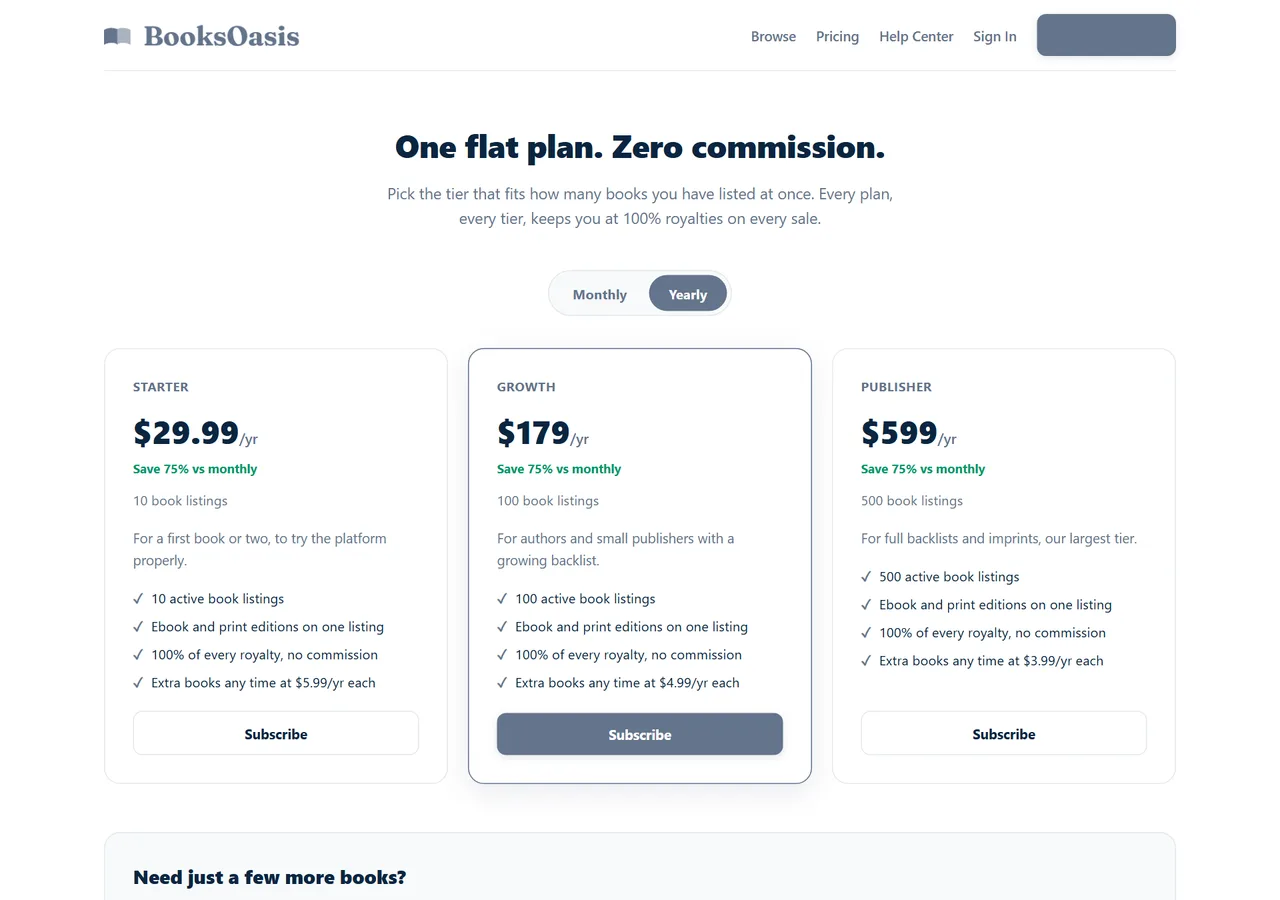
BooksOasis is an independent bookstore for ebooks, paperbacks and hardcovers. Like a retailer, it handles checkout, delivery and reading, and readers browse it by genre, author and series. Like selling direct, you keep 100% of your ebook price, with no commission and no processing cut, for a flat yearly plan. It's a practical middle path: somewhere to send your readers that pays you in full, without building a shop.
What BooksOasis does not do
- It doesn't give you buyers' email addresses.
- It doesn't distribute to other retailers; it's one more store.
- The plan costs a flat fee whether or not you sell.
Reviewing your split each year
Once a year, look at where your income actually came from: each retailer, your direct store and any bookstore listings. Compare it with the time each took. If one retailer brings most of your sales, it may be worth going direct with it rather than through an aggregator. If direct sales have grown, consider better tools or more exclusives. If a channel brings almost nothing, simplify. The right split changes as your catalogue and readership grow.
Three authors, three splits
A debut author sells almost entirely through retailers while she builds her newsletter, and adds a direct bundle once her second book is out.
A long-running series author with a large list sells box sets and signed paperbacks direct, keeps retailers for new readers, and lists every book on BooksOasis for readers who prefer to buy there.
A non-fiction author who speaks at events sells print copies direct at talks, sends online buyers to a single store link, and uses retailers for discovery.
Common mistakes
- Going direct-only too early, before there's an audience to sell to.
- Staying retailer-only forever, with no way to contact readers.
- Undercutting your own retail prices so much that stores price-match.
- No reason to buy direct beyond "it helps me".
- Ignoring tax on direct sales.
In short
Retailers bring readers; direct sales bring margin and relationships. Use retailers for discovery, build a newsletter from the first book, sell bundles and exclusives direct, and consider a bookstore that pays 100% of the ebook price as a middle path. Then follow your readers: put effort where they actually buy.
Questions
Is selling direct better than selling on Amazon?
Per sale, usually yes: you keep more. But retailers bring readers you'd never reach alone. Most authors do both: retailers for discovery, direct for their own readers.
How much more do I keep selling direct?
On a $4.99 ebook, about $4.30 through Payhip's free plan versus about $3.34 on KDP (70% minus a small delivery charge) or $3.49 at a store paying 70%.
What are the downsides of selling direct?
You bring every buyer yourself, handle file delivery and support, and may need to manage sales tax. Readers are also used to buying from big stores and may hesitate on an unfamiliar site.
Why do authors sell direct at all?
Higher margins, customer email addresses, freedom to create bundles and special editions, and less dependence on one retailer's rules.
Can I sell direct if I'm in KDP Select?
Not the ebook. KDP Select requires the ebook to be exclusive to Amazon for each 90-day term. You can still sell print books and other formats direct.
What's the easiest way to start selling direct?
A creator storefront or a bookstore author page. Both take minutes and handle payment and delivery.
Do retailers give me customer data?
No. Retailers keep the customer relationship. Invite readers to your newsletter from your book's back matter.
Where does BooksOasis fit?
In between: it's a bookstore where readers browse and buy, but you keep 100% of your ebook price for a flat yearly plan, like selling direct without building a store.
Will selling direct hurt my retailer rankings?
Sales you move to your own store don't count towards a retailer's rankings. Many authors send launch-week buyers to one retailer for visibility and use direct sales for bundles and extras.
What should I sell direct first?
Bundles, box sets, signed paperbacks and newsletter exclusives: things retailers don't offer, so readers have a clear reason to buy from you.
Should I sell print books direct?
It depends on effort. Ordering author copies and shipping them yourself suits signed copies and events. For everyday print orders, a store that prints on demand and ships for you saves time.
How many newsletter subscribers do I need to sell direct?
There's no fixed number, but direct sales come almost entirely from readers who already know you. A few hundred engaged subscribers can make a direct offer worthwhile.
How do I make readers trust my own store?
Show clear prices, say what format they'll receive and how to read it, link a help page and refund policy, and give a real contact email.
The middle path: a bookstore where you keep 100%
List on BooksOasis alongside your retailers and direct store, from $29.99 a year.