Payhip and Gumroad are the two storefronts authors mention most when they want to sell ebooks directly. Both are free to start, both give you your customers' email addresses, and both deliver files automatically. The differences are in the fees, the tax handling and the extras.
Payhip vs Gumroad at a glance
| Payhip | Gumroad | |
|---|---|---|
| Monthly fee | $0, $29 or $99 | None |
| Per-sale fee | 5% (Free), 2% (Plus), 0% (Pro) | 10% + $0.50 direct; 30% via Discover |
| Card processing | Extra (PayPal or Stripe rates) | Extra, per independent fee breakdowns |
| Sales tax | EU and UK VAT handled; says US and Canada too | Merchant of record worldwide since January 2025 |
| Marketplace | No browsing marketplace | Discover |
| Features | All features on every plan | Digital products, memberships |
| Customer emails | Yes | Yes |
| Print books | No | No |
What you keep per sale
| Price | Payhip Free | Payhip Plus | Payhip Pro | Gumroad (direct) | Gumroad (Discover) |
|---|---|---|---|---|---|
| $2.99 | $2.45 | $2.54 | $2.60 | $1.80 | $2.09 |
| $4.99 | $4.30 | $4.45 | $4.55 | $3.55 | $3.49 |
| $9.99 | $8.90 | $9.20 | $9.40 | $7.90 | $6.99 |
| $19.99 | $18.11 | $18.71 | $19.11 | $16.61 | $13.99 |
Example calculations with card processing assumed at 2.9% + $0.30 per sale. Payhip Plus and Pro figures exclude their monthly fees. Gumroad Discover figures show the 30% fee only, before any processing.
Gumroad's $0.50 fixed fee hurts most on cheap ebooks: at $2.99 it takes about a sixth of the price before processing. The gap narrows as prices rise, but Payhip stays ahead at every price.
Over a year
| $4.99 ebook, sales a year | Payhip Free | Gumroad (direct) | Payhip keeps you |
|---|---|---|---|
| 50 | $214.79 | $177.31 | $37.47 more |
| 200 | $859.16 | $709.26 | $149.90 more |
| 1,000 | $4,295.79 | $3,546.29 | $749.50 more |
Same assumptions as above. The difference column is Payhip Free minus Gumroad, rounded.
Sales tax: Gumroad's biggest advantage
Selling digital products internationally brings sales tax and VAT obligations. Since January 2025, Gumroad acts as merchant of record, meaning it handles sales tax collection and remittance worldwide on your behalf. That removes a real administrative burden.
Payhip collects and remits EU and UK VAT on digital sales and says it now handles US and Canadian sales tax as well. For other countries, check Payhip's current tax pages. If you sell to buyers all over the world and want tax fully off your plate, Gumroad's model is simpler; if most buyers are in the EU, UK, US or Canada, Payhip covers the main cases.
Gumroad Discover: help or cost?
Discover is Gumroad's marketplace, where buyers browse products. Sales it brings you cost 30%. For ebooks, most authors find nearly all their Gumroad sales come from their own newsletter and social followers, where the 10% + $0.50 applies. Treat Discover as an occasional bonus rather than a reason to choose Gumroad.
Features beyond the fees
| Feature | Payhip | Gumroad |
|---|---|---|
| Ebook and file delivery | Yes | Yes |
| Courses | Yes | Digital products |
| Memberships and subscriptions | Yes | Yes |
| Coupons | Yes | Yes |
| Affiliates | Yes | Yes |
| Custom storefront | Yes | Profile page |
Both cover what most authors need. Payhip leans towards a store you shape yourself; Gumroad leans towards a creator profile inside a larger community.
Getting paid
The two work differently. Payhip connects to your own PayPal or Stripe account, so buyers' payments go through those processors and you manage the money from there. Gumroad collects payments itself and pays creators out by direct deposit or PayPal, with options that vary by country. If you're outside the US or UK, check which payout methods each supports where you live before committing.
The reader's experience
On both platforms, the buyer pays, receives a download link by email, and gets the file (usually EPUB or PDF). Then they have to load it onto their reading app or e-reader. For tech-comfortable readers that's easy; for others it's a common source of support emails. A short "how to read this ebook" note on your product page, with links for Kindle, Kobo, Apple Books and Google Play Books, saves a lot of back and forth. See how readers load direct-sale ebooks for wording you can borrow.
Pricing on a storefront
- Avoid very low prices on Gumroad. The $0.50 fixed fee makes $0.99 and $1.99 ebooks barely worthwhile.
- Bundle to cut fixed fees. A three-book bundle is one transaction, so the fixed part of the processing fee (and Gumroad's $0.50) is charged once instead of three times. It can also lift the average order value.
- Offer newsletter exclusives. Storefronts are ideal for bonus chapters, extended editions and early releases your retail stores don't carry.
- Keep prices consistent with your retail listings so readers don't feel penalised for buying from you directly.
Which is better for a series?
For a series, the storefront's job is usually bundles and extras rather than single volumes, since most readers find book one on a retailer. Payhip's lower cut makes it the better home for box sets. If you want each volume discoverable by readers browsing a store, list the series on a bookstore as well: on BooksOasis, a series page shows every volume in order, and readers can buy the first three or the complete set at one price.
What neither does
- Print books. You'll need KDP Print, IngramSpark, Books.by or a bookstore with print on demand.
- Browsing readers of books. Neither is a bookstore; you bring nearly every buyer yourself.
- Reading apps. Buyers download files and load them onto their own devices.
A third option: a flat-fee bookstore
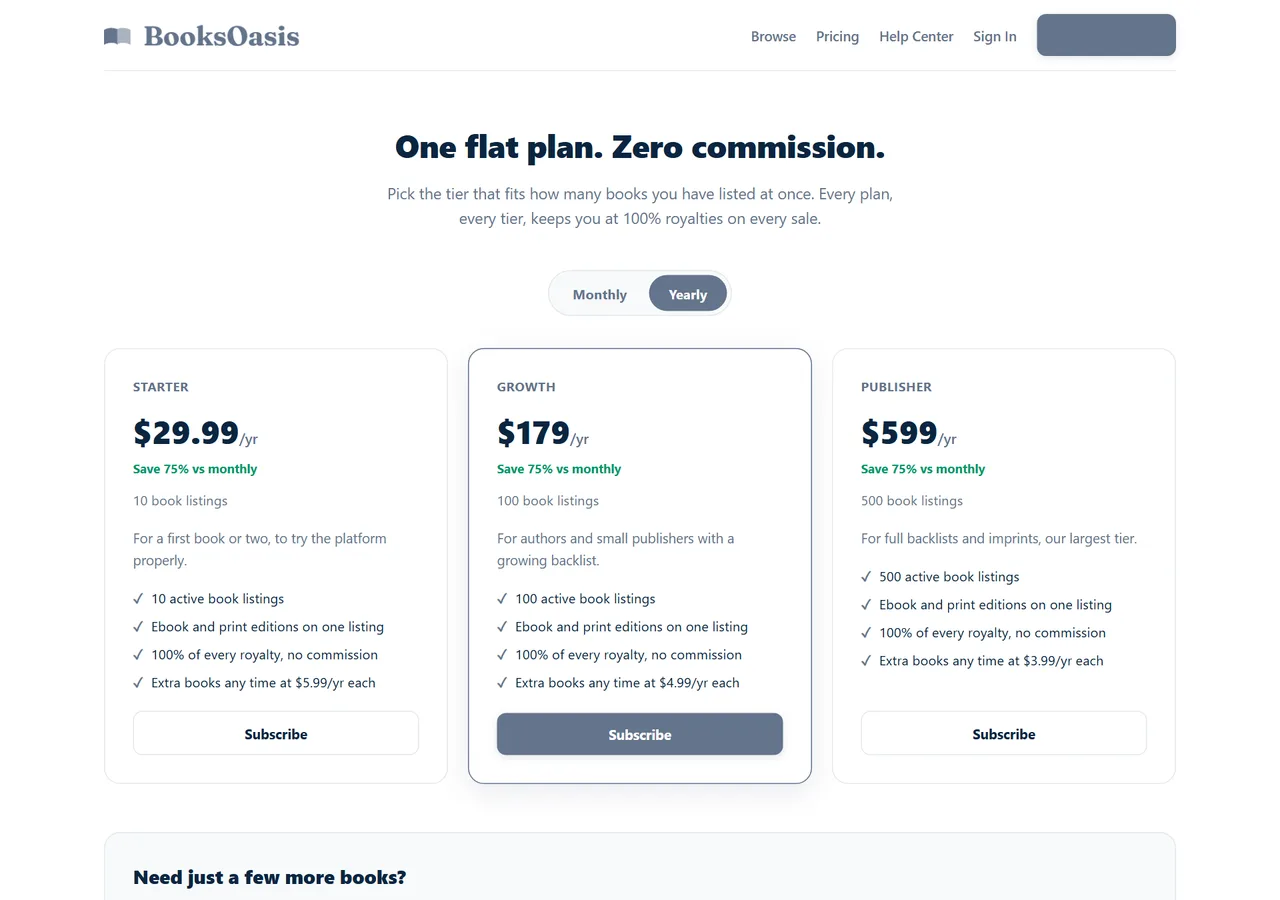
BooksOasis is an independent bookstore for ebooks, paperbacks and hardcovers. Instead of a percentage, you pay a flat yearly plan and keep 100% of your ebook price, with no processing cut. Readers browse it by genre, author and series, and ebooks open in Oasis Reader in any browser, so there are no files to deliver.
| $4.99 ebook, sales a year | Payhip Free | Gumroad | BooksOasis Starter ($29.99/yr) |
|---|---|---|---|
| 50 | $214.79 | $177.31 | $219.51 |
| 200 | $859.16 | $709.26 | $968.01 |
| 1,000 | $4,295.79 | $3,546.29 | $4,960.01 |
What BooksOasis does not do
- It doesn't give you buyers' email addresses; invite readers to your newsletter from your book's back matter.
- It isn't a storefront on your own domain, and it sells books only, not courses or memberships.
- The plan costs a flat fee whether or not you sell.
Which should you choose?
| If you... | Choose |
|---|---|
| Sell ebooks mostly to your own newsletter | Payhip Free |
| Sell worldwide and want tax fully handled | Gumroad |
| Already have a following on Gumroad | Gumroad |
| Sell courses or memberships alongside books | Payhip |
| Want print and browsing readers too | Add a bookstore such as BooksOasis |
| Sell high volumes at higher prices | Compare Payhip Plus or Pro, or a flat-fee store |
When Payhip's paid plans make sense
Against Payhip's own free plan, Plus ($348 a year) saves 3 percentage points per sale, so it pays off above about $11,600 of yearly revenue. Pro ($1,188 a year) saves 5 points and pays off above about $23,760. Most authors selling ebooks direct never reach those levels, which is why Payhip Free is usually the fair comparison with Gumroad.
Common mistakes on either platform
- Pricing ebooks at $0.99 on Gumroad, where fixed fees leave almost nothing.
- Forgetting processing fees when comparing, which makes both look cheaper than they are.
- Relying on the storefront for discovery. Neither brings many new book readers on its own.
- No reading instructions, which leads to refund requests from readers who can't open the file.
- Ignoring tax settings until a large international sale arrives.
Switching from Gumroad to Payhip
- Recreate your products on Payhip with the same files, descriptions and prices.
- Export your customer list from Gumroad and invite buyers to your newsletter.
- Keep Gumroad open for a while so past buyers can still download their files.
- Update every link in back matter, your website and social profiles.
- Review tax settings on Payhip, since tax handling differs from Gumroad's merchant-of-record model.
Checklist before you choose
- Work out what you keep per sale at your actual prices, including processing.
- Check which countries most of your buyers are in, and how each platform handles tax there.
- Confirm payout methods available where you live.
- Decide whether you need courses or memberships as well as ebooks.
- Plan where readers who don't follow you yet will find your books.
Three authors, three choices
A romance author with a 5,000-reader newsletter moved her bonus epilogues and box sets from Gumroad to Payhip Free and kept about $0.75 more on every $4.99 sale.
A technical writer selling $29 guides worldwide stays on Gumroad, because its merchant-of-record tax handling saves him hours of VAT paperwork.
A fantasy author keeps Payhip for newsletter exclusives and lists every book on BooksOasis, where fantasy readers browse the shelves and she keeps the full ebook price.
Sources
Checked September 2026: Payhip pricing; Gumroad pricing; Gumroad fee breakdown; Payhip tax handling.
In short
Payhip is cheaper than Gumroad for ebooks at every price, and its free plan is hard to beat for a small storefront. Gumroad wins on worldwide tax handling and community. For keeping every dollar of the ebook price and reaching readers who browse, add a flat-fee bookstore like BooksOasis.
Questions
Is Payhip cheaper than Gumroad?
For ebooks, yes, at most prices. Payhip's free plan takes 5% per sale; Gumroad takes 10% plus $0.50. Card processing applies on top of both. On a $4.99 ebook you keep about $4.30 on Payhip Free and about $3.55 on Gumroad.
What does Gumroad charge?
10% plus $0.50 per sale through your profile or direct links, and 30% on sales that come through its Discover marketplace. There's no monthly fee.
What does Payhip charge?
Free plan: 5% per sale. Plus: $29 a month and 2%. Pro: $99 a month and no transaction fee. Payhip says PayPal and Stripe processing fees apply on all plans.
Which handles sales tax better?
Gumroad has acted as merchant of record since January 2025, handling sales tax collection and remittance worldwide. Payhip collects and remits EU and UK VAT on digital sales and says it now handles US and Canadian sales tax too; check its current tax pages for other countries.
Does Gumroad's Discover marketplace help ebooks sell?
It can bring new buyers, but those sales cost 30%. Most authors find their Gumroad sales come from their own audience rather than Discover.
Can I sell print books on Payhip or Gumroad?
Both are built for digital products. For print on demand, authors use KDP Print, IngramSpark, Books.by or a bookstore such as BooksOasis.
Which is better for courses and memberships?
Both support digital products beyond ebooks. Payhip includes courses and memberships on every plan; Gumroad supports memberships and other digital products.
Do I get customer emails on both?
Yes. Both give you buyers' email addresses, which is one of the main reasons authors use a storefront.
Can I use Payhip or Gumroad alongside BooksOasis?
Yes. Many authors keep a storefront for newsletter offers and list their books on BooksOasis, where readers browse and you keep 100% of the ebook price.
Which is better for a first ebook?
Payhip Free, for most authors: no monthly fee and a lower cut than Gumroad. Choose Gumroad if you already have an audience there or want its merchant-of-record tax handling.
How does each platform pay me?
Payhip connects to your own PayPal or Stripe account. Gumroad collects payments and pays out by direct deposit or PayPal, with options that vary by country.
Is Gumroad's merchant-of-record status worth the higher fee?
It can be if you sell to buyers in many countries and would otherwise handle sales tax yourself. If most buyers are in the EU, UK, US or Canada, Payhip's tax handling may be enough at a lower cost.
Keep 100% of your ebook price
No commission, no processing cut, from $29.99 a year.