Direct selling used to mean building a website, wiring up payments and emailing files. Today there are simpler options, some of which handle everything from payment to reading. This guide compares the main approaches, shows what each costs, and walks you through setting up.
Why sell direct at all?
- More money per sale. Retailers typically keep about 30% of an ebook's price; direct sales can pay you all of it.
- Less dependence on one company. Your income doesn't hinge on any single retailer's rules or algorithm.
- Freedom with pricing and bundles. Sell series bundles, special editions and launch offers on your own terms.
- A closer relationship with readers. Readers who buy from you directly tend to be your most loyal.
Four ways to sell ebooks direct
| Approach | Examples | You keep | Effort |
|---|---|---|---|
| Shared bookstore with full margin | BooksOasis | 100% of the ebook price, for a flat plan | Low: payment, delivery and reading handled |
| Author-focused direct platform | Books.by | 100% minus processing, for a yearly plan | Low to medium |
| General digital shop | Payhip, Gumroad | Price minus a percentage and processing | Low to medium; you deliver files |
| Your own website shop | Shopify or WooCommerce with BookFunnel | Price minus processing and subscriptions | High |
Option 1: a shared bookstore that pays the full price
A shared bookstore gives you a store page, handles checkout and delivers the book, while you keep the ebook price. On BooksOasis:
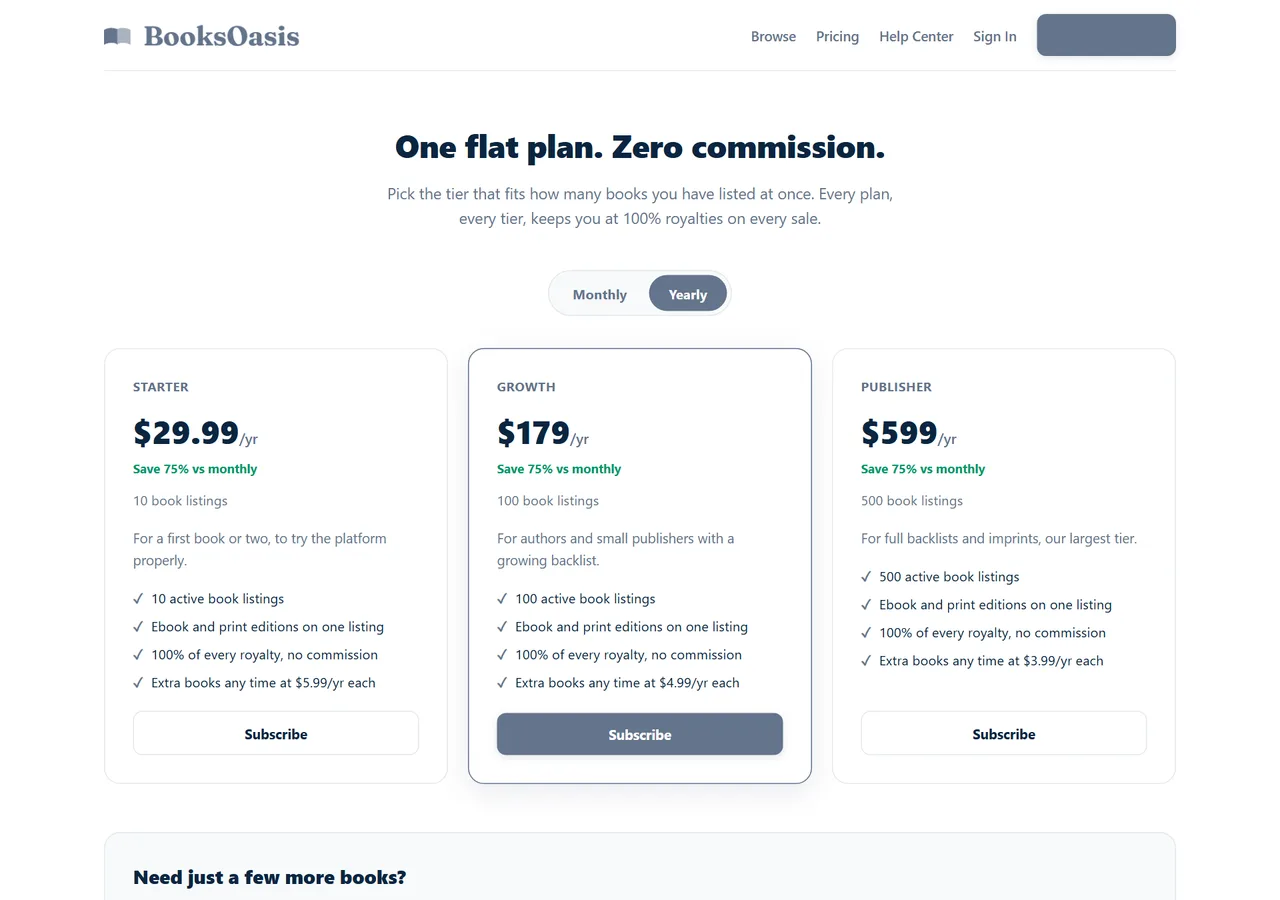
- You keep 100% of the ebook price, for a flat plan from $29.99 a year for 10 books.
- Readers pay at the BooksOasis checkout and read instantly in Oasis Reader, on any phone, tablet or computer, online or offline.
- Your books appear on genre shelves, in search and on your author and publisher pages, so readers can discover you as well as buy from your links.
- Readers can buy a whole series from its series page, and you can add paperback and hardcover editions to the same listing.
Trade-off: readers keep their accounts with the store, so you don't receive their email addresses.
Option 2: an author-focused direct platform
Books.by gives each author a branded bookstore, 100% of sales minus card processing, daily payouts and buyer details, for a yearly plan ($99 paperback-only, $299 with ebooks). It suits authors with an audience who want their own branded store.
Option 3: a general digital shop
Payhip and Gumroad let you sell ebook files quickly. Payhip charges 5% per sale on its free plan (less on paid plans), Gumroad 10% plus $0.50, both plus processing. You deliver files, and you get buyer emails. See Gumroad alternatives.
Option 4: your own website shop
For complete control, run a shop on your own website with Shopify or WooCommerce, and use a delivery service such as BookFunnel to send files and help readers load them. It is the most flexible and the most work: you design, maintain and market the shop, and handle support.
What it costs: 500 sales of a $4.99 ebook in a year
| Approach | Fees in a year | You keep |
|---|---|---|
| BooksOasis Starter | $29.99 | $2,465.01 |
| Payhip free | About $347 | About $2,148 |
| Books.by Pro | About $521 | About $1,974 |
| Gumroad | About $722 | About $1,773 |
| A 70% retailer, for comparison | About $749 | About $1,747 |
Example calculations on $2,495 of sales. Processing modelled at 2.9% + $0.30 where passed on. Your own website costs vary by plan and services.
Delivery: files or a reading app?
How readers receive your ebook affects both their experience and your workload.
| File delivery (EPUB, PDF) | Reading app (Oasis Reader) | |
|---|---|---|
| Reader experience | Download, then move the file to a device or app | Tap Read now; the book opens on any device |
| Support requests | Common: "How do I get this on my Kindle?" | Rare |
| Sharing risk | Files can be forwarded | Books stay inside the app |
| Reader freedom | Any compatible app | Oasis Reader only, online and offline |
Tax and legal basics
Selling direct can bring tax responsibilities, especially sales tax or VAT on digital products, which can depend on where the buyer lives. Some platforms handle this for you; if you run your own shop, it may fall to you. Check who is responsible before choosing, and keep records of all sales. See records every author should keep.
Getting readers to your direct store
A direct store only earns if readers find it. The most effective channels:
- Your newsletter. Your most loyal readers, and the easiest to send to one store.
- The back of your books. Readers who just finished book one want book two now; link to your direct store.
- Your website. Make "Buy direct" the first option on every book page.
- Social media and events. Share one simple direct link.
- Launch offers. Give early readers a reason to buy direct, such as a launch price or bonus content.
Setting up, step by step
- Choose your approach.Shared bookstore, direct platform, digital shop or your own site, or a combination.
- Prepare your files.A clean EPUB, a cover image, and print files if you sell print.
- Write strong book pages.Title, subtitle, description, categories and keywords, just as carefully as for retailers.
- Set prices.Keep them consistent with your retail listings to avoid price matching problems.
- Publish and test.Buy your own book once to check the whole experience.
- Update every link.Newsletter, website, social profiles and back matter.
- Tell your readers.Explain simply why buying direct helps you.
Pricing direct: launch offers and bundles
Direct stores give you freedom that retailers don't always allow, but consistency still matters.
- Launch offers: a limited-time promotional price for the first week rewards readers who buy direct and keeps its full value on a flat-fee store.
- Series bundles: offer the first three books, or the whole series, together. On BooksOasis, readers can buy the first books or a complete series from its series page.
- Keep list prices aligned: run promotions for set periods rather than permanently undercutting your retail prices.
Building a mailing list alongside direct sales
Your mailing list is the engine of direct sales. Build it independently of any store:
- Offer a free reader magnet, such as a short story or bonus chapter, for signing up.
- Link to your sign-up page at the end of every book, on retail and direct editions alike.
- Send a short, regular email, not only when you have a launch.
- When you announce a book, link to your direct store first, and retailers second.
Selling print direct
Direct stores aren't just for ebooks. Print books sold direct avoid retailer discounts, so you keep much more per copy. On BooksOasis, you can add paperback and hardcover editions to the same listing; copies are printed on demand when a reader orders, the printing cost and a 30% handling fee on that cost come out first, and readers pay shipping. For a $16.99 paperback costing $5.00 to print, that leaves you $10.49 a copy.
Protecting your ebook when selling direct
Any ebook can be copied by someone determined to, but some delivery methods make casual sharing much harder. File downloads can be forwarded in seconds; books read inside an app stay there. If piracy worries you, prefer an app-based store for direct sales. See protecting your ebook from piracy.
Common mistakes
- Expecting strangers to find a standalone store. Standalone stores rely on the traffic you send.
- Undercutting your retail prices. Amazon may match lower prices, reducing your royalties there.
- Choosing file delivery for non-technical readers. Expect support emails.
- Ignoring tax. Know who handles sales tax and VAT before your first sale.
- Splitting readers across too many stores. Give your audience one clear direct link.
Measuring what works
Track where direct sales come from so you can do more of what works. Use a different link for your newsletter, website and social profiles where your store allows it, note sales around each email you send, and compare months. Even simple tracking shows which channel sends your most loyal readers.
Direct sales and your retail listings
Selling direct doesn't mean leaving retailers. The most successful indie authors use both: retailers put books in front of strangers, and direct stores keep the full price from readers who already know them. One exception to watch: if an ebook is enrolled in KDP Select, it can't be sold anywhere else, including direct, while enrolled.
Selling direct with BooksOasis
- 100% of every ebook sale, for a flat plan from $29.99 a year.
- Payment, delivery and reading handled; readers read instantly in Oasis Reader.
- A shared store where new readers can discover your books too.
What it doesn't do: BooksOasis doesn't share buyers' email addresses or distribute to other retailers. Every book passes a short moderation review.
See plans and pricingIn short
Selling ebooks direct lets you keep up to the full price of every sale. The easiest route is a store that handles payment, delivery and reading for you; the most controlled is your own website shop. Whichever you choose, keep your retail listings, send your own readers to your direct store, and let the difference add up book by book.
Questions
What does selling ebooks direct mean?
Selling to readers yourself, through your own store, a direct platform or a shared bookstore that pays you the full price, rather than through a retailer that keeps around 30% of each sale.
What is the easiest way to sell ebooks direct?
Listing on a bookstore that handles payment, delivery and reading for you. On BooksOasis, you list your book, readers buy, and they read instantly in Oasis Reader, with 100% of the ebook price going to you.
Do I need a website to sell ebooks direct?
No. Shared bookstores and direct platforms give you a store page. A website helps you build your brand and mailing list, but isn't required to start.
How do readers receive ebooks bought direct?
Either as a file download, such as an EPUB, or through a reading app. File delivery needs readers to move the file to their device; a reading app opens the book instantly.
Should I stop selling on Amazon if I sell direct?
Usually not. Direct sales work best alongside retailers: retailers bring new readers, and direct sales keep more of the money from readers who already know you.
How much can I earn selling ebooks direct?
Up to the full price per sale on a flat-fee store, compared with about 70% at most retailers. On 500 sales of a $4.99 ebook, that difference is roughly $750 in a year.
Is selling direct worth it with a small audience?
Yes, if costs are low. A low-cost flat plan pays for itself after a few dozen sales a year, and your direct sales grow as your newsletter does.
Can I sell direct if my ebook is in KDP Select?
No. KDP Select requires the ebook to be exclusive to Amazon while enrolled, which rules out selling it direct. Print editions can still be sold direct.
Do I need to handle refunds when selling direct?
It depends on the platform. On a shared bookstore like BooksOasis, the store handles checkout and its published refund policy. On your own shop, refunds and support are up to you.
Can I sell direct under a pen name?
Yes. On BooksOasis, a subscribed account can create unlimited author names and imprints, and readers only see the public identity you choose.
Start selling direct today
List on BooksOasis and keep 100% of every ebook sale.