Finding your book on a pirate site for the first time feels awful. It helps to know that it happens to almost every author with a readership, that most people who download pirated books were never going to buy them, and that there are practical, low-cost steps that reduce the damage. This guide covers them.
What piracy looks like
| Type | Example | What helps |
|---|---|---|
| Casual sharing | Emailing a file to a friend | DRM or reader-app delivery |
| File-sharing sites | Uploads to download sites | Takedown notices to the host |
| Search results | Pirate pages ranking for your title | Search engine removal requests |
| Fake listings | Your book resold by someone else on a store | Report to the store |
| Leaked advance copies | A review copy shared before launch | Careful distribution, watermarks |
DRM: what it does and doesn't do
DRM (digital rights management) ties an ebook file to a store's approved apps and devices, so a copied file won't simply open anywhere. That stops casual forwarding. It doesn't stop people who set out to remove it, and it can frustrate honest readers who want to read on a different device.
| With DRM | DRM-free | |
|---|---|---|
| Casual sharing | Harder | Easy |
| Determined pirates | Slowed, not stopped | Not stopped |
| Reader convenience | Limited to approved apps | Any compatible app |
| Reader goodwill | Some readers dislike it | Many readers appreciate it |
Most stores let you choose DRM when you publish. Decide deliberately rather than leaving the default, and read each store's rules on whether the setting can be changed later.
Reader-app delivery
Another approach is to deliver ebooks inside a reading app rather than as files at all. The reader opens the book in the store's app or browser reader, signed in to their account, and never receives a file to forward. It's a practical middle ground: easy for honest readers on their own devices, and much harder to share casually.
Watermarks
A watermark marks a file with the buyer's details, visibly or invisibly. It doesn't prevent copying, but it discourages sharing by making copies traceable, and it's less restrictive for readers than DRM. Some direct-sale and book delivery tools offer watermarking; check what yours supports.
When you find a pirated copy
- Record it.Save the page address, a screenshot and the date.
- Find the host.Look for a contact, abuse or copyright page on the site; if there isn't one, look up who hosts the site.
- Send a takedown notice to the site or its host (see below).
- Ask search engines to delist the page through their copyright removal forms.
- Keep a log of what you sent and when, and follow up if nothing happens.
Writing a takedown notice
A takedown notice formally asks a host to remove material that infringes your copyright. In the US it's often called a DMCA notice; many countries have similar processes. A notice typically includes:
- Your name and contact details, and that you're the copyright owner (or authorised to act for them).
- The work being infringed: title, author and where the legitimate version is sold.
- The exact addresses of the infringing copies.
- A statement that you believe in good faith the use isn't authorised.
- A statement that the information is accurate, and your signature.
Many hosts and platforms have their own web form for this. Use it where one exists. Be accurate and polite; false or careless notices can have legal consequences, so only report copies you're sure are yours.
Removing pirate pages from search results
Pirate sites often reappear under new addresses, but they rely on search traffic. Search engines such as Google run copyright removal processes where you can report specific infringing pages. Delisting doesn't delete the site, but it pushes pirated copies out of sight of readers searching for your book, which is where most of the harm happens.
Keeping your own files safe
Piracy sometimes starts with an author's own files: a manuscript left in a public cloud folder, or a review copy sent to the wrong address. Keep master files in private storage, share links with access controls, and never post full files publicly. Treat your final EPUB and print PDF like any valuable document, and remove old share links once they have served their purpose.
Fake listings on stores
Occasionally someone uploads another author's book to a store under their own account. Report it to the store through its copyright or content reporting process, with links to your own legitimate listing and evidence that you're the author. Stores generally act quickly on clear cases.
Protecting advance copies
- Choose readers carefully: people you know, or readers with a track record of honest reviews.
- Use a delivery service that tracks or watermarks copies, where available.
- Ask plainly that readers don't share the file.
- Don't send copies too early: a few weeks before release is usually enough.
Make buying easier than pirating
The strongest long-term defence isn't technical. Readers pirate most when books are hard to get, expensive, or unavailable in their country or format. You can't fix every case, but you can:
- Sell in many places and in every format readers want.
- Price fairly, with occasional deals.
- Make series easy to find and buy in reading order.
- Build a relationship through your newsletter, so readers want to support you.
Libraries and lending aren't piracy
Readers borrowing your ebook from a public library, or lending a paperback to a friend, is legitimate and often good for you: it introduces new readers who may buy your next book. Library ebook platforms pay for their copies under licences. Don't confuse this with piracy, and don't discourage it; many devoted readers find authors through their library first.
Availability and price across countries
Some piracy happens because a book simply isn't available, or is priced far out of reach, where the reader lives. Selling through stores that reach many countries, offering every format, and setting sensible local prices removes that reason. Stores with a web reader also help readers in places where certain apps or devices aren't common.
A monthly routine
- Search your titles with words like "free", "PDF" and "EPUB".
- Note the top results that offer your book without permission.
- Send takedown notices through each host's form.
- Submit search removal requests for the same pages.
- Update your log, and stop there until next month.
Thirty minutes a month catches the copies most likely to be found by readers. Chasing every obscure upload rarely pays for the time.
Three authors, three approaches
A thriller author keeps DRM on at major stores, sends advance copies only through a tracked delivery service, and spends half an hour a month on takedowns.
A fantasy author sells DRM-free on principle, finding readers value it, and puts her effort into a newsletter and fair series pricing instead.
A non-fiction author sells ebooks through a reader-app store as well as retailers, so readers who buy there never receive a file, and uses search removal requests for the few pirate pages that rank for his title.
How BooksOasis delivers ebooks
BooksOasis ebooks aren't downloaded as files. Readers open them in Oasis Reader, in their browser on any phone, tablet or computer they sign in to. Offline reading is supported, but an offline download stays inside the reader on that device rather than becoming a file to send on. Readers can copy short passages (up to 400 characters at a time) and share quote images with the book's title and author, which helps word of mouth without handing over the book.
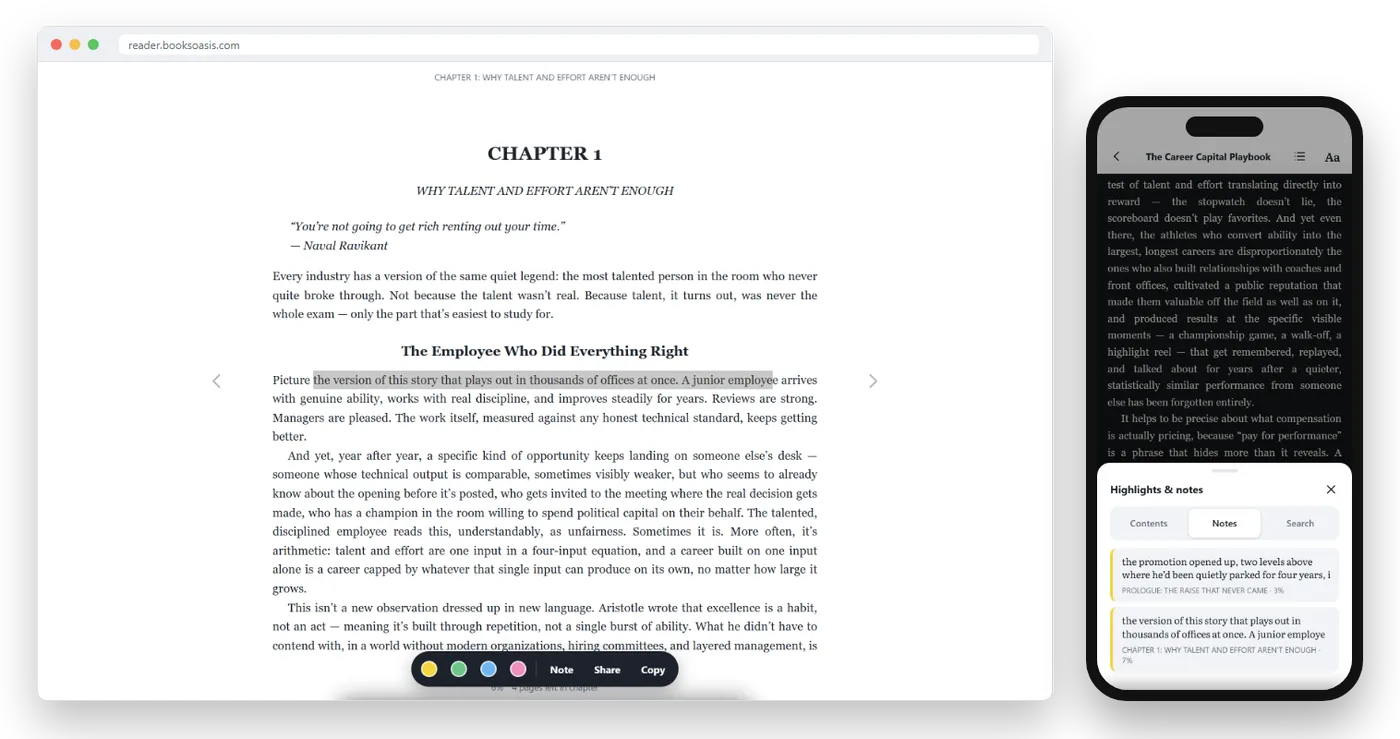
- No downloadable files to email or upload.
- Signed-in reading on the reader's own devices.
- Short-passage copying only.
- 100% of your ebook price on every sale, for a flat yearly plan.
What BooksOasis does not do
- No system makes piracy impossible; reader-app delivery makes casual sharing much harder, not impossible.
- It doesn't monitor pirate sites or send takedown notices for you.
- It doesn't protect copies you sell or distribute elsewhere.
Common mistakes
- Spending hours every week chasing every copy instead of writing.
- Arguing with pirate sites rather than using formal notices and search removal.
- Sending advance copies to strangers without any tracking.
- Punishing honest readers with restrictions they find frustrating.
- Filing notices for copies you have not checked are really your book.
In short
Accept that piracy can't be eliminated, and aim to reduce it: make casual sharing harder with DRM or reader-app delivery, send takedown notices and search removal requests when copies appear, protect your advance copies, and make legitimate buying simple and fair. Then get back to writing, which does more for your income than any anti-piracy effort.
Questions
Can I stop ebook piracy completely?
No. Any book that can be read can eventually be copied by a determined person. The realistic goals are to make casual sharing harder, act quickly when copies appear, and make buying easier than pirating.
Does DRM stop piracy?
It makes casual sharing harder, since files open only in approved apps. It doesn't stop determined pirates, and it can inconvenience honest readers.
Should I sell my ebook DRM-free?
It's a trade-off. DRM-free files are easier for readers to use on any device; some authors find the goodwill worth more than the small protection DRM adds. Others prefer DRM for peace of mind.
What is a takedown notice?
A formal request asking a website host or platform to remove material that infringes your copyright. In the US it's often called a DMCA notice; many countries have similar processes.
Can I get pirate sites removed from Google?
You can ask Google to remove specific infringing pages from its search results through its copyright removal process. It doesn't delete the site, but it makes it much harder to find.
Do I need to register copyright to send a takedown?
Generally no: copyright exists when you create the work. Some legal actions, such as suing for damages in the US, may require registration. Check the rules where you live.
How do I protect advance review copies?
Send them only to readers you trust, use delivery services that watermark or track copies where available, and ask readers not to share files.
Does piracy really cost sales?
It's hard to measure. Many people who download pirated books would never have bought them. Focus on making legitimate buying easy and affordable, and on removing copies that rank prominently.
How does BooksOasis protect ebooks?
BooksOasis ebooks open in Oasis Reader and aren't downloaded as files. Readers open them on devices they sign in to, offline downloads stay inside the reader on that device, and copying is limited to short passages.
Should I pay a piracy-monitoring service?
Some authors find them useful at high sales volumes. For most, a monthly search for your titles and sending takedowns yourself is enough.
Is library lending a form of piracy?
No. Libraries license ebooks and lend them legitimately, and borrowing often introduces readers who go on to buy your other books.
How much time should I spend on piracy?
A short monthly routine is enough for most authors: search your titles, send takedowns and search removal requests for the top results, and log what you did.
Can readers share passages from BooksOasis ebooks?
Yes, in small amounts. Readers can copy up to 400 characters at a time and share quote images showing the book's title and author, which helps word of mouth.
Sell ebooks readers can't simply forward
BooksOasis ebooks open in Oasis Reader, not as downloadable files.