Most authors didn't start writing to do accounts, and it shows. Royalty statements pile up, receipts sit in email, and a year's worth of numbers gets sorted in a panic before a tax deadline. It doesn't have to be like that. This guide sets out a simple system you can run in under an hour a month. It covers record-keeping only; for tax questions, speak to a qualified accountant in your country.
Why bookkeeping matters for authors
Bookkeeping isn't just for tax. It's how you find out whether your books are a hobby that costs money or a business that makes it. It answers questions such as: which book earns the most? Did that advertising campaign pay for itself? Is a hardcover worth offering? Can I afford a professional editor for the next book? Without records, those decisions are guesses.
It also protects you. If a platform underpays, a payment goes missing, or a tax authority asks questions, clear records let you answer quickly and confidently.
The three lists
1. Income
Record what each book earned on each platform, by month. You can take this straight from each platform's royalty report.
| Month | Platform | Book | Format | Units | Earnings |
|---|---|---|---|---|---|
| Sep 2026 | BooksOasis | Book one | Ebook | 14 | $69.86 |
| Sep 2026 | Store B | Book one | Ebook | 30 | $104.70 |
| Sep 2026 | BooksOasis | Book one | Paperback | 3 | $22.50 |
Example figures for illustration only.
2. Expenses
Record every book-related cost with its date, amount, category, which book it relates to (or "general"), and where the receipt is.
| Category | Examples |
|---|---|
| Editorial | Developmental editing, copyediting, proofreading |
| Design | Cover design, interior formatting, illustrations |
| Publishing | Publishing plans, ISBNs, author copies, proofs |
| Marketing | Ads, promotion sites, giveaways, newsletter service |
| Tools | Writing and formatting software, stock images, fonts |
| Website | Domain, hosting, email |
| Professional | Accountant, legal advice, memberships |
Which expenses count for tax depends on local rules, so record everything and let your accountant decide.
3. Payouts
Record each payment that actually arrives: platform, the sales month it covers, the amount expected, the amount received, and any difference. This is where you spot fees, currency losses, refunds and missing payments. See how author payouts work for why these figures often differ.
A monthly routine
- Download statements from each platform for last month and save them in a dated folder.
- Add income rows for each book and platform.
- Record payouts that arrived, and compare with what you expected.
- Add expenses from your card, bank and email receipts.
- File receipts in the same folder, named with date, supplier and amount.
- Glance at the totals: income, expenses and profit for the month and year to date.
Set a recurring reminder for the same day each month. Once it's a habit, it takes less time than you'd think.
Profit per book
The most useful number in your records is profit per book. Add up everything a book earned across platforms and formats, then subtract the costs tied to it, such as editing, cover and ads for that book. Shared costs, such as software, a website or a yearly publishing plan, can be split across your catalogue in whatever way you find fair, as long as you apply it consistently.
| Line | Amount |
|---|---|
| Income, all platforms, year to date | $1,420 |
| Editing | -$600 |
| Cover | -$250 |
| Ads for this book | -$180 |
| Share of general costs | -$60 |
| Profit so far | $330 |
Example figures for illustration only.
Seen this way, a book that looks disappointing in its first months may be on track to earn back its costs, and a book with high sales may be losing money to ads. See author earnings per book and flat plan break-even for more on the numbers.
Recording print sales correctly
Print sales need a little more care than ebooks, because costs sit between the price the reader pays and what reaches you. Record the earnings figure the platform reports, which already has printing and any fees taken off, rather than the cover price. If you buy author copies to sell at events, record the copies you bought as an expense, and each copy you sell by hand as income, so you can see whether events are worth your time.
Keep an eye on printing cost changes too. If a platform's printing cost for your book rises, your earnings per copy fall even though the price stays the same. Noting the cost alongside the earnings each quarter shows you when it's time to review the price. See paperback vs hardcover profit for how formats compare.
Budgeting for the next book
Good records don't just look back; they help you plan. Once you know what your last book cost to produce and how quickly it earned back, you can set a realistic budget for the next one. Many authors set aside a share of each payout into a separate pot for the next book's editing and cover, so production is funded by the catalogue rather than by savings. Your profit-per-book table tells you how big that share can safely be.
Keeping receipts without the pain
- One folder per year, with subfolders for statements, receipts and tax forms.
- Consistent file names such as 2026-09-14 cover-designer 250.pdf, so you can find anything by searching.
- Forward email receipts to one address or label, and save them monthly.
- Photograph paper receipts on the day.
Tracking whether ads pay for themselves
Advertising is often an author's biggest variable cost, and it's the easiest to lose track of. For each campaign, record the book, the platform, the dates, what you spent and the sales you can reasonably link to it. Then compare the extra royalties with the spend. If a book normally earns $40 a month and earns $140 during a campaign that cost $80, the campaign made about $20 before counting any longer-term effect, such as readers going on to buy the rest of a series.
That longer-term effect is why series authors often accept a small loss on ads for book one. Your records let you check whether the later books really do make up the difference, instead of hoping they do.
Common bookkeeping mistakes
- Recording sales as income before they're paid and then forgetting to check the payout arrived. Keep reported earnings and received payouts in separate lists.
- Mixing personal and book spending on one card, so expenses are hard to find later.
- Losing small receipts. A $12 font licence or a $9 stock image looks trivial until there are fifty of them.
- Ignoring refunds and reversals, which make income look higher than it is.
- Leaving it all until year end, when statements have expired from dashboards and memories have faded.
- Forgetting currency differences between what a platform reports and what reached your account.
A year-end checklist
- Check every month is complete for every platform: statements saved, income and payouts recorded.
- Download annual summaries and any tax documents each platform provides.
- Total income and expenses by category, and profit per book for the year.
- Note anything unusual: a large refund, a missing payment, an expense you're unsure about.
- Hand the folder to your accountant, or use it to complete your own return if that's appropriate where you live.
- Start next year's folder the same day, so January doesn't begin in a muddle.
A separate bank account
Many authors find that a separate bank account for book income and expenses makes bookkeeping dramatically easier. When every transaction in the account is book-related, your bank statement becomes most of your records. Check local rules and any account fees; in some countries there are specific requirements once you trade as a business.
Spreadsheet or software?
| Option | Good for | Keep in mind |
|---|---|---|
| Spreadsheet | New authors, a few books and platforms | Needs discipline; easy to customise |
| Accounting software | Growing catalogues, several platforms, bank feeds | Subscription cost; setup time |
| Accountant | Tax returns, business structure, complex income | A fee, often worth it once income is steady |
Currencies and international income
If you sell in several currencies, record both the original amount and the amount received in your own currency, with the date. Conversion differences are real costs, and tax authorities often have rules on which exchange rate to use. See international author payouts for more.
When to bring in an accountant
A good accountant pays for themselves when your income becomes regular, when you sell across several countries, when you're deciding whether to set up a company, or when you simply don't want to worry about getting tax wrong. Clean monthly records also make an accountant's work quicker, which usually means a smaller bill.
How BooksOasis helps
On BooksOasis, every ebook and print sale is written to an earnings ledger you can see from your dashboard, showing what came in and what it earned you. Ebooks pay their full price, so the income line is simple. For print, the printing cost and a handling fee of 30% of that printing cost come out first, and the rest is yours. A flat yearly plan is one predictable expense to record, rather than a commission taken from every sale.
Where BooksOasis fits
- A ledger of every sale, ready to copy into your records.
- No commission on ebooks, so income per sale equals the price.
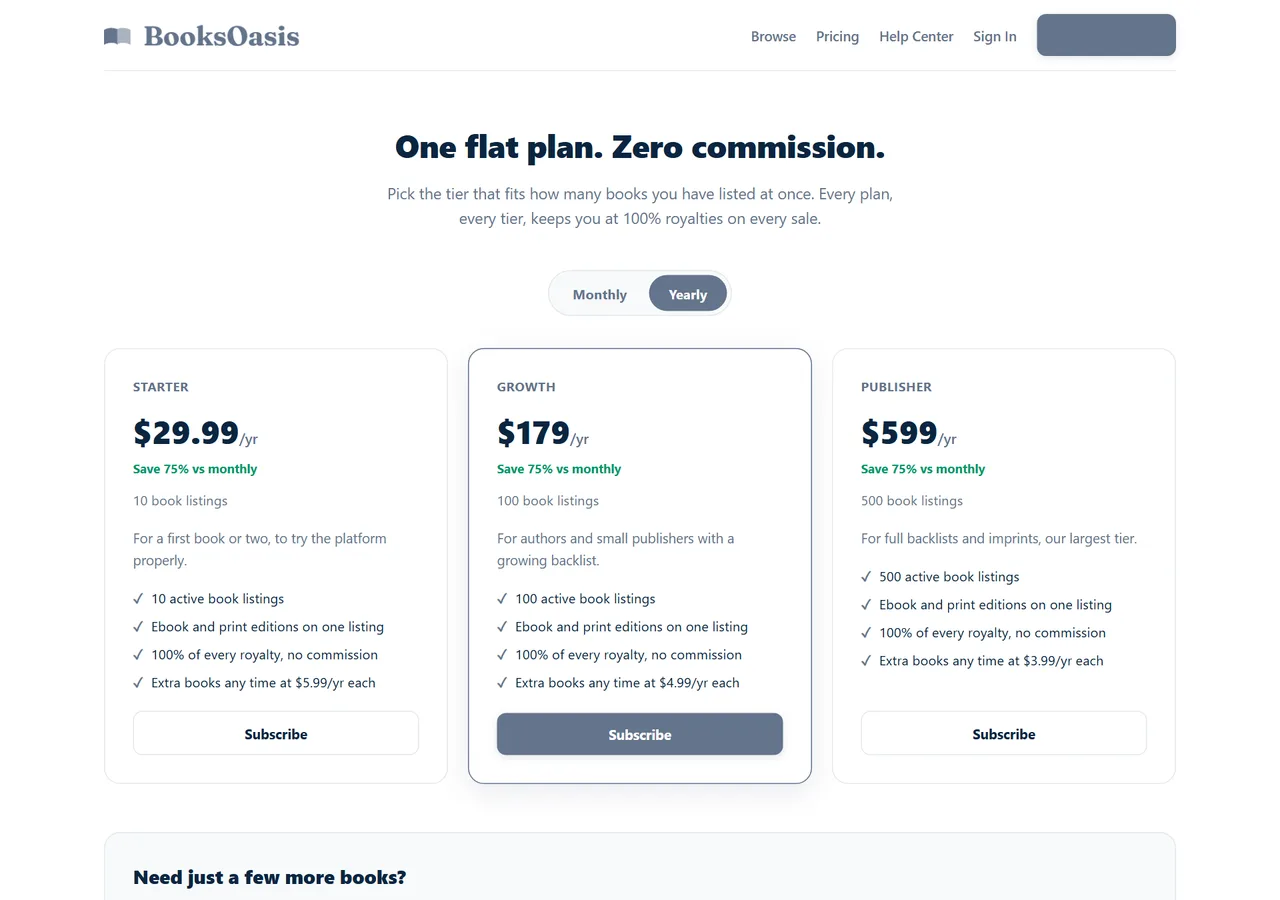
- One flat plan a year, from $29.99 for 10 books.
What it doesn't do: BooksOasis doesn't provide accounting software, file tax returns or give tax advice.
See plans and pricingThree authors, three systems
A first-time author runs one spreadsheet with three tabs and spends 30 minutes on the first Sunday of each month.
A series author with eight books tracks profit per book and discovered that one title's ads were costing more than it earned.
An author with steady income moved to accounting software with a bank feed and hands clean records to an accountant each year.
In short
Keep three lists, income, expenses and payouts, update them monthly, file receipts with clear names, and work out profit per book. It takes an hour a month and turns guesswork into decisions. For anything tax-related, bring in a qualified accountant with your tidy records in hand.
Questions
Do self-published authors need to do bookkeeping?
If you earn money from books, keeping records of income and expenses helps you understand profit, answer questions from tax authorities and plan your next book. The rules depend on your country; ask an accountant.
What should an author record?
Income by platform, book and month; expenses by category with receipts; and payouts received. Those three lists answer most questions.
What expenses do authors typically have?
Editing, cover design, formatting, ISBNs, advertising, software and subscriptions, publishing plans, author copies, website costs and professional fees. Which are deductible depends on local tax rules.
Do I need accounting software?
Not at first. A spreadsheet works well for most new authors. Software can help as your catalogue and platforms grow.
How often should I update my books?
A short monthly routine is enough: download statements, record payouts, add expenses and file receipts.
Should I open a separate bank account?
Many authors find a separate account makes bookkeeping far easier, because every transaction in it is book-related. Check local rules and fees.
How do I work out profit per book?
Add up a book's income across platforms, subtract costs tied to that book (editing, cover, ads), and share general costs across your catalogue in a way you apply consistently.
How long should I keep records?
It depends on your country's rules. Keep statements and receipts for at least as long as your tax authority requires, and ask an accountant if unsure.
Does BooksOasis provide sales records?
Yes. Every ebook and print sale is written to an earnings ledger you can see from your dashboard.
Is this tax advice?
No. This guide covers record-keeping. For tax questions, speak to a qualified accountant in your country.
Every sale, recorded for you
BooksOasis keeps a ledger of each sale. Plans from $29.99 a year.