Hardcovers used to be out of reach for self-published authors. Now KDP, B&N Press, IngramSpark and BooksOasis all print them on demand. That makes the question practical: is a hardcover worth adding, and how should it be priced?
Printing costs compared (KDP, Amazon.com)
| Black ink, regular trim | Paperback | Hardcover | Difference |
|---|---|---|---|
| 100 pages | $2.30 | $6.80 | $4.50 |
| 200 pages | $3.40 | $8.05 | $4.65 |
| 300 pages | $4.60 | $9.25 | $4.65 |
| 400 pages | $5.80 | $10.45 | $4.65 |
| 500 pages | $7.00 | $11.65 | $4.65 |
Paperback: $2.30 flat to 110 pages, then $1.00 + $0.012 per page. Hardcover: $6.80 flat for 75 to 108 pages, then $5.65 + $0.012 per page up to 550 pages. From KDP's printing cost help pages.
Because both formats charge the same $0.012 per page, the gap is almost constant: the hardcover's case and board add about $4.65 whatever the length. That's why hardcovers make more sense for longer, higher-priced books, where $4.65 is a smaller share of the price.
What you earn per copy
For a 300-page book on KDP (Amazon.com, 60% royalty at $9.99 and above).
| Format | List price | Printing | You earn |
|---|---|---|---|
| Paperback | $12.99 | $4.60 | $3.19 |
| Paperback | $14.99 | $4.60 | $4.39 |
| Paperback | $17.99 | $4.60 | $6.19 |
| Hardcover | $19.99 | $9.25 | $2.74 |
| Hardcover | $24.99 | $9.25 | $5.74 |
| Hardcover | $29.99 | $9.25 | $8.74 |
Example calculations: 60% of list price minus printing.
The lesson: a hardcover priced only a few dollars above the paperback earns less per copy. At $19.99 it earns $2.74, less than a $12.99 paperback. A hardcover needs a genuinely premium price to be worth it.
Minimum prices
KDP sets the minimum list price at the printing cost divided by the royalty rate. For the 300-page example:
- Paperback ($4.60 to print): about $9.20 at the 50% rate that applies below $9.99.
- Hardcover ($9.25 to print): about $15.42 at the 60% rate.
At the minimum you earn nothing, so real prices sit well above it. B&N Press sets a $14.99 floor for all print books since May 2026.
Volume: why paperbacks usually win overall
Most readers choose the cheaper print format. Suppose, for illustration, a book sells ten paperbacks for every hardcover:
| Illustration, 300-page book on KDP | Copies | Per copy | Total |
|---|---|---|---|
| Paperback at $14.99 | 500 | $4.39 | $2,195 |
| Hardcover at $24.99 | 50 | $5.74 | $287 |
The ratio is an assumption for illustration only; your own mix depends on genre and audience.
The hardcover adds income, and costs nothing to keep listed once it is set up. But it rarely replaces the paperback. Offer it as an addition, and let readers choose the edition that suits them, whether that is a copy to read on the train or one to give.
When a hardcover is worth offering
| Book type | Hardcover? | Why |
|---|---|---|
| Gift books, devotionals, poetry collections | Often yes | Bought as presents; readers value a lasting edition |
| Flagship non-fiction | Yes | Libraries, offices and readers who keep reference books |
| Series fans | Collector editions | Loyal readers buy matching hardcovers |
| Genre fiction read once | Optional | Paperback and ebook carry most sales |
| Very short books | Rarely | The $6.80 flat cost is a big share of a low price |
Pricing the formats together
| Format | Typical role | Example price (300 pages) |
|---|---|---|
| Ebook | Cheapest, widest reach | $4.99 to $9.99 |
| Paperback | Everyday print edition | $14.99 to $17.99 |
| Hardcover | Premium, gift, keeper | $24.99 to $29.99 |
Keep the ebook at least 20% below your cheapest print edition if Kobo matters to you, since that's a condition of Kobo's 70% ebook rate. With a $14.99 paperback, that means $11.99 or less. See how to price an ebook.
The same book on BooksOasis
BooksOasis is an independent bookstore for ebooks, paperbacks and hardcovers. Print editions are printed on demand; the dashboard quotes each edition's printing cost, and you earn the list price minus that cost and a 30% handling fee on it. The reader pays shipping, and the publisher's plan is a flat yearly fee.
| 300-page book, same printing cost assumed | List price | KDP | BooksOasis |
|---|---|---|---|
| Paperback ($4.60 to print) | $14.99 | $4.39 | $9.01 |
| Hardcover ($9.25 to print) | $24.99 | $5.74 | $12.96 |
Illustration using KDP's printing cost for both platforms; actual BooksOasis quotes appear in your dashboard for each edition.
Because BooksOasis doesn't take a percentage of the price, the hardcover's higher price flows mostly to you, which makes a premium edition more worthwhile there.
What BooksOasis does not do
- It doesn't distribute hardcovers or paperbacks to other retailers or bookstores.
- Every copy is printed on demand; there are no offset runs.
- The plan costs a flat fee whether or not you sell.
Color hardcovers
Picture books, cookbooks and art books are natural hardcovers, but color changes the maths. On KDP, a premium-color hardcover in a regular trim costs $5.65 plus $0.065 per page. A 40-page children's book isn't eligible (color hardcovers start at 75 pages on KDP), but an 80-page cookbook costs about $10.85 to print, and a 150-page one about $15.40. Price these books with printing cost firmly in view, and compare the paperback's much lower cost before deciding.
Collector editions for a series
For a series with loyal readers, matching hardcovers can become a small but steady income stream. Readers who loved the ebooks often want the whole set on the shelf. A few things help: consistent spine design across volumes, the series name and number clearly on the spine, and announcing each hardcover to your newsletter. On BooksOasis, a series page lists every volume in order, so readers can see the full set at a glance.
Libraries and institutions
Libraries often prefer hardcovers for durability, and companies buying a book for their teams may choose the hardcover as the "official" copy. If your book is the kind that ends up in libraries or offices, a hardcover makes it easier for those buyers to say yes. Wider bookstore and library ordering usually runs through a distributor such as IngramSpark rather than a single retailer.
Checklist before adding a hardcover
- Check the page count against each platform's hardcover limits.
- Work out the printing cost and the minimum price.
- Choose a premium price that earns at least as much per copy as the paperback.
- Create a hardcover cover from the platform's own template.
- Assign an ISBN if the platform requires a separate one.
- Order a proof and check the spine, wrap and binding.
Common mistakes
- Pricing the hardcover just above the paperback, which earns less per copy.
- Reusing the paperback cover file, which won't fit the case wrap.
- Adding hardcovers to very short books, where the flat cost swallows the price.
- Forgetting the ebook gap, leaving the ebook too close to print for Kobo's 70% rate.
Practical tips for hardcovers
- Design the cover for the format. Case-laminate hardcovers need their own cover template with wrap-around allowance.
- Check page limits. Black-ink KDP hardcovers run 75 to 550 pages; BooksOasis hardcovers 24 to 800.
- Order a proof. Hardcover spines and wraps are easy to get slightly wrong, and a printed copy shows problems a screen never will.
- Use the same ISBN rules as any edition: each format needs its own ISBN where the platform requires one.
- Mention the hardcover as a gift option in your newsletter before holidays, birthdays and graduation season, when readers are looking for presents.
Reviewing your format mix
After six months, look at sales by format. If hardcovers sell only a handful of copies but earn well per copy, keep them listed: they cost nothing to maintain. If a hardcover never sells, consider whether it's priced too high for the genre, or whether readers simply don't know it exists; a mention in your newsletter and on your author page often helps. If paperbacks lag far behind ebooks, check the print price against similar books in your category.
Three authors, three choices
A devotional author added hardcovers at $24.99 to her 30-day devotionals and found they sell steadily before Christmas and Easter as gifts.
A thriller writer kept paperbacks only for his series, because his readers buy once and move on, and a hardcover's higher price didn't fit the genre.
A business author priced a 400-page hardcover at $29.99 for companies buying copies for teams, earning about $7.54 per KDP copy against $4.99 on a $17.99 paperback.
Sources
Checked September 2026: KDP hardcover printing cost; KDP paperback printing cost; B&N Press May 2026 updates; Kobo Writing Life agreement.
In short
A hardcover costs about $4.65 more to print than a paperback on KDP, so it only earns more per copy at a genuinely premium price, roughly $8 to $12 above the paperback. Paperbacks usually bring most print income; hardcovers add gift and keeper sales at little extra effort. Offer both where the book suits it, price them clearly apart, and remember that on a flat-fee store the hardcover's premium price mostly stays with you.
Questions
Is a hardcover more profitable than a paperback?
Per copy, often yes, if priced as a premium edition: a 300-page hardcover at $24.99 earns about $5.74 on KDP, against $4.39 for the paperback at $14.99. But most readers buy the paperback, so total profit usually comes mainly from paperbacks.
How much more does a hardcover cost to print?
On KDP (Amazon.com), about $4.50 to $4.65 more per copy for black-ink books. A 300-page book costs about $4.60 as a paperback and $9.25 as a hardcover.
What is KDP's hardcover printing cost?
For black ink in a regular trim: $6.80 flat for 75 to 108 pages, and $5.65 plus $0.012 per page for 110 to 550 pages. Premium color is $5.65 plus $0.065 per page.
What is the minimum hardcover price on KDP?
Printing cost divided by the royalty rate. For a 300-page hardcover costing $9.25, that's about $15.42 at the 60% rate.
What page counts can KDP hardcovers have?
Black-ink KDP hardcovers run from 75 to 550 pages. BooksOasis hardcovers can run from 24 to 800 pages.
Should every book have a hardcover?
Not necessarily. Hardcovers suit gift books, flagship non-fiction, collector editions of a series and books readers keep. For genre fiction read once, the paperback and ebook usually carry the sales.
How should I price a hardcover?
High enough to earn a proper royalty above its printing cost, and clearly above the paperback. Many self-published hardcovers sit $8 to $12 above the paperback.
Does a hardcover help paperback sales?
It can. A higher-priced hardcover next to the paperback makes the paperback look like good value, and some readers want the premium edition as a gift.
How are hardcovers handled on BooksOasis?
Like paperbacks: printed on demand, with the dashboard quoting the printing cost. You earn the list price minus that cost and a 30% handling fee on it, and the reader pays shipping.
Do hardcovers affect my ebook price?
Kobo pays 70% only if the ebook is at least 20% below every print edition, so check the gap to your cheapest print format, usually the paperback.
Can I make a color hardcover on KDP?
Yes, with premium color ink from 75 pages. On Amazon.com it costs $5.65 plus $0.065 per page in a regular trim, so an 80-page book costs about $10.85 to print.
Why does my hardcover earn less than my paperback?
Usually because it's priced too close to the paperback. The hardcover costs about $4.65 more to print on KDP, so it needs a price roughly $8 to $12 higher to earn more per copy.
Do libraries prefer hardcovers?
Often, because hardcovers last longer on the shelf. Library ordering usually runs through a distributor such as IngramSpark rather than a single retailer.
Offer every format, keep more of each
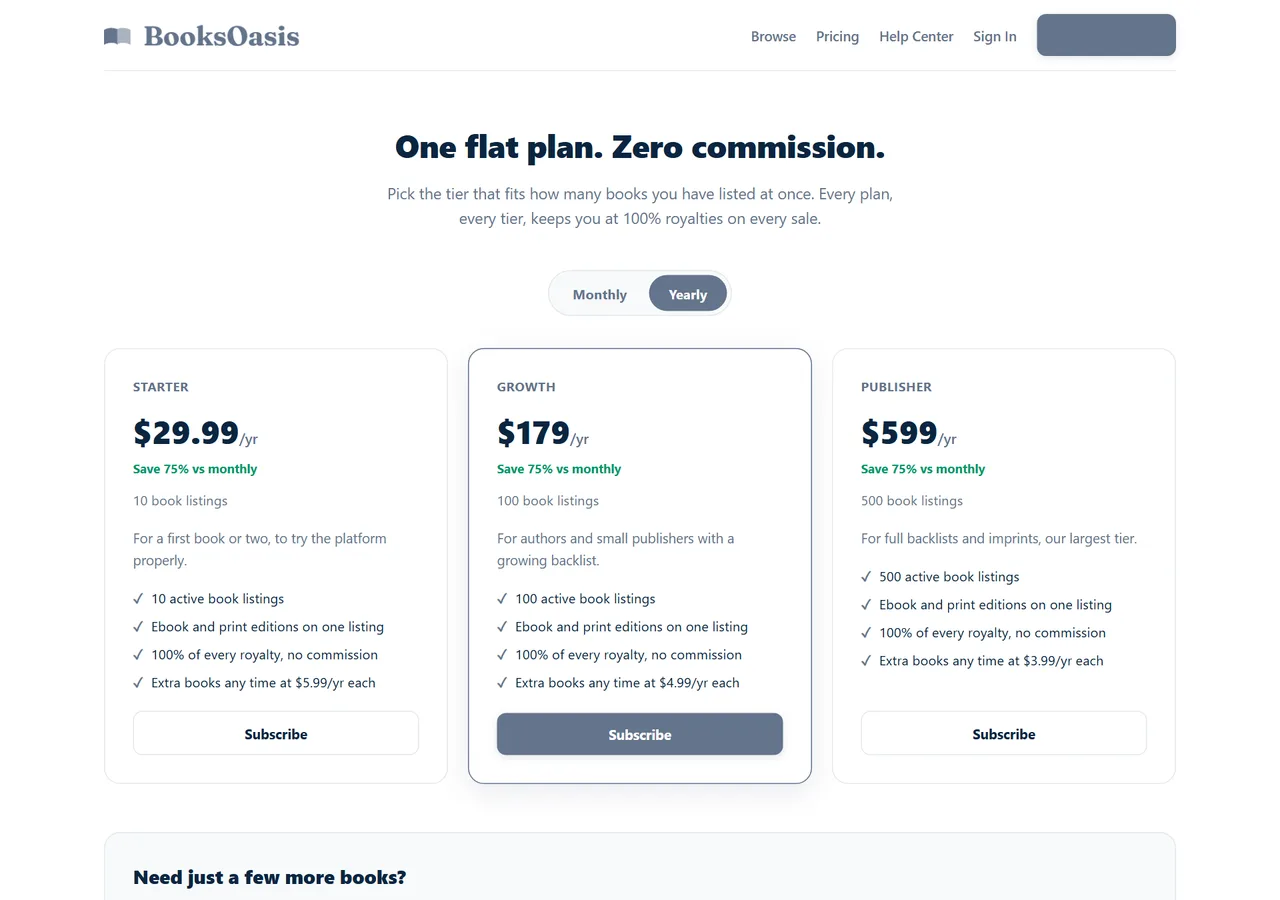
Ebook, paperback and hardcover on BooksOasis, from $29.99 a year.