Pricing feels like guesswork, but it doesn't have to be. A few principles, and a clear picture of how each store pays at each price, will get you to a sensible number quickly. This guide covers genre ranges, royalty bands, series and box sets, launches, promotions, international prices and how to test.
The three things that set an ebook's price
- Reader expectations. Readers compare your book with similar books. Price far above the genre and they hesitate; far below and they wonder why.
- Royalty rules. Stores pay different percentages at different prices, so a small change can halve or double what you earn per copy.
- Your goals. Maximum readers, maximum income per copy, or drawing readers into a series all point to different prices.
Typical ebook prices by genre
These are common ranges for indie-published ebooks. Check the current bestsellers in your own subgenre before deciding.
| Type of book | Common indie price range |
|---|---|
| Romance, thrillers, fantasy (series) | $0.99 to $4.99, first in series often lowest |
| Mystery and cosy mystery | $2.99 to $5.99 |
| Literary and general fiction | $3.99 to $7.99 |
| Short stories and novellas | $0.99 to $2.99 |
| Box sets and omnibus editions | $4.99 to $12.99 |
| Non-fiction, self-help, business | $4.99 to $12.99 |
| History and biography | $4.99 to $9.99 |
| Devotionals and faith | $2.99 to $9.99 |
General ranges for guidance only; prices vary by subgenre, length and author.
Royalty bands: the rules that matter most
| Store | Price band for the higher rate | Rate outside the band |
|---|---|---|
| Amazon KDP (Amazon.com) | $2.99 to $12.99 earns 70% minus delivery | 35% |
| Kobo Writing Life | $2.99 and up earns 70% (ebook at least 20% below print) | 45% |
| Barnes & Noble Press | 70% at $0.99 and above | No upper band |
| Apple Books | 70% at all prices | No band |
| Google Play Books | 70% in most countries | No band in those countries |
| BooksOasis | 100% at any price | No band |
Amazon's upper limit rose from $9.99 to $12.99 on July 7, 2026.
The practical rule: if Amazon matters to you, keep ebooks between $2.99 and $12.99; for Kobo, stay at $2.99 or above.
What you earn at each price
| Price | Amazon (1 MB) | Kobo | Apple or B&N | BooksOasis |
|---|---|---|---|---|
| $0.99 | $0.35 | $0.45 | $0.69 | $0.99 |
| $2.99 | $1.94 | $2.09 | $2.09 | $2.99 |
| $3.99 | $2.64 | $2.79 | $2.79 | $3.99 |
| $4.99 | $3.34 | $3.49 | $3.49 | $4.99 |
| $6.99 | $4.74 | $4.89 | $4.89 | $6.99 |
| $9.99 | $6.84 | $6.99 | $6.99 | $9.99 |
| $14.99 | $5.25 | $10.49 | $10.49 | $14.99 |
Example calculations. Try other prices in the royalty calculator.
Pricing by length
Length shapes expectations, especially in fiction. Readers feel short works should cost less, and long works can carry more.
| Length | Typical indie ebook price |
|---|---|
| Short story (under 10,000 words) | $0.99 |
| Novella (20,000 to 40,000 words) | $0.99 to $2.99 |
| Novel (60,000 to 100,000 words) | $2.99 to $5.99 |
| Long novel (over 120,000 words) | $4.99 to $7.99 |
| Non-fiction guide | $4.99 to $9.99 |
General guidance; your genre's norms come first.
The psychology of price points
Readers respond to familiar price points. Prices ending in .99 are the norm for ebooks, and $2.99, $3.99, $4.99 and $9.99 act as anchors readers recognise. Moving from $4.99 to $5.49 rarely changes how cheap a book feels, but crossing $4.99 to $5.99 can. Test around the anchors rather than between them.
New author or established author?
An unknown author asks readers to take a risk, so a lower price, especially on a first book or series opener, lowers the barrier. An author with a loyal readership can price closer to the top of the genre range, because readers already know what they are getting. Many authors raise prices gradually as their catalog and reviews grow.
When free ebooks work
Free can be powerful, used deliberately. A permanently free first book in a long series can bring a steady flow of readers into the paid books. A free short story or novella in exchange for a newsletter sign-up builds your list. Free rarely makes sense for a standalone with nothing to buy next, and some stores restrict setting a permanent price of zero, so check each store's rules.
Pricing a series
Series are where pricing strategy pays off most. Common approaches:
- Low first book: book one at $0.99 to $2.99, or free on some stores, with later books at full price. Readers who love book one buy the rest.
- Consistent pricing: every book at the same price, simple and fair.
- Rising prices: later, longer books priced a little higher.
- Series bundles: the first three or the whole series together at a saving.
On BooksOasis, readers can buy the first books or a whole series from its series page. More in series pricing: first-in-series deals and box sets.
Box sets and bundles
A box set gives readers several books for less than buying each one. Price it well below the sum of the books, often around the price of two, so it feels like a real saving. On Amazon.com, prices above $12.99 drop to 35%, which is why many box sets sit at $9.99 to $12.99 there; stores without an upper band leave more room.
Launch pricing
A launch price rewards early readers and helps a new book gather momentum. Common patterns: a lower price for the first week, then the regular price; or a pre-order at the regular price with a launch-week discount for newsletter readers.
On BooksOasis, you can set a promotional price with a start and end date, and readers see your regular price struck through beside it.
Promotions and discounts
- Check the band. A discount below $2.99 drops Amazon and Kobo to their lower rates, except during a Kindle Countdown Deal for KDP Select books.
- Keep it temporary. Permanent discounts train readers to wait.
- Promote the first book to lift sales of the whole series.
- Keep stores consistent. Amazon may match lower prices it finds elsewhere, which affects your royalty there.
See ebook promotions that work.
Ebook vs print pricing
Readers expect the ebook to cost clearly less than the paperback, and the paperback less than the hardcover. A common pattern is an ebook at $4.99 to $9.99, a paperback at $14.99 to $19.99 and a hardcover at $24.99 to $29.99, depending on length and genre. Print prices must also cover printing costs: on BooksOasis, a print edition's minimum price is its printing cost plus a 30% handling fee on that cost.
International pricing
Stores let you set prices per country or convert automatically from your US price. Converted prices often end in odd amounts; many authors round to familiar price points in each currency, such as 2.99 or 4.99. Check that each local price stays inside that store's royalty band in that currency.
Pricing non-fiction
Non-fiction readers are buying a result: knowledge, a skill, a solution. They are usually less price-sensitive than fiction readers, and more interested in whether the book delivers. A practical guide that solves a real problem can sit comfortably at $6.99 to $12.99. Make sure your subtitle and description state the promise clearly, because that is what justifies the price.
A worked example
An author has a four-book fantasy series. She prices book one at $2.99 to draw readers in, books two to four at $4.99, and a box set of all four at $12.99. On Amazon.com, every price sits inside the 70% band. A reader who buys all four individually spends $17.96; the box set saves them about $5, and still earns her 70% minus delivery on Amazon, and the full $12.99 on BooksOasis.
How to test a price
- Choose a starting price from your genre's range, inside the royalty bands.
- Leave it for a few weeks to get a baseline of daily sales.
- Change one thing, such as the price of book one.
- Compare income, not just copies. Fewer sales at a higher price can earn more.
- Watch the whole series. A cheaper book one may lift sales of books two to five.
Common pricing mistakes
- $13.99 on Amazon, earning 35% instead of 70%.
- Every book at $0.99, earning 35% on Amazon and signalling low value.
- Pricing like a traditional publisher's hardback ebook without the name recognition.
- Ebook priced almost as high as the paperback.
- Never changing the price, even when sales stall.
Where BooksOasis fits
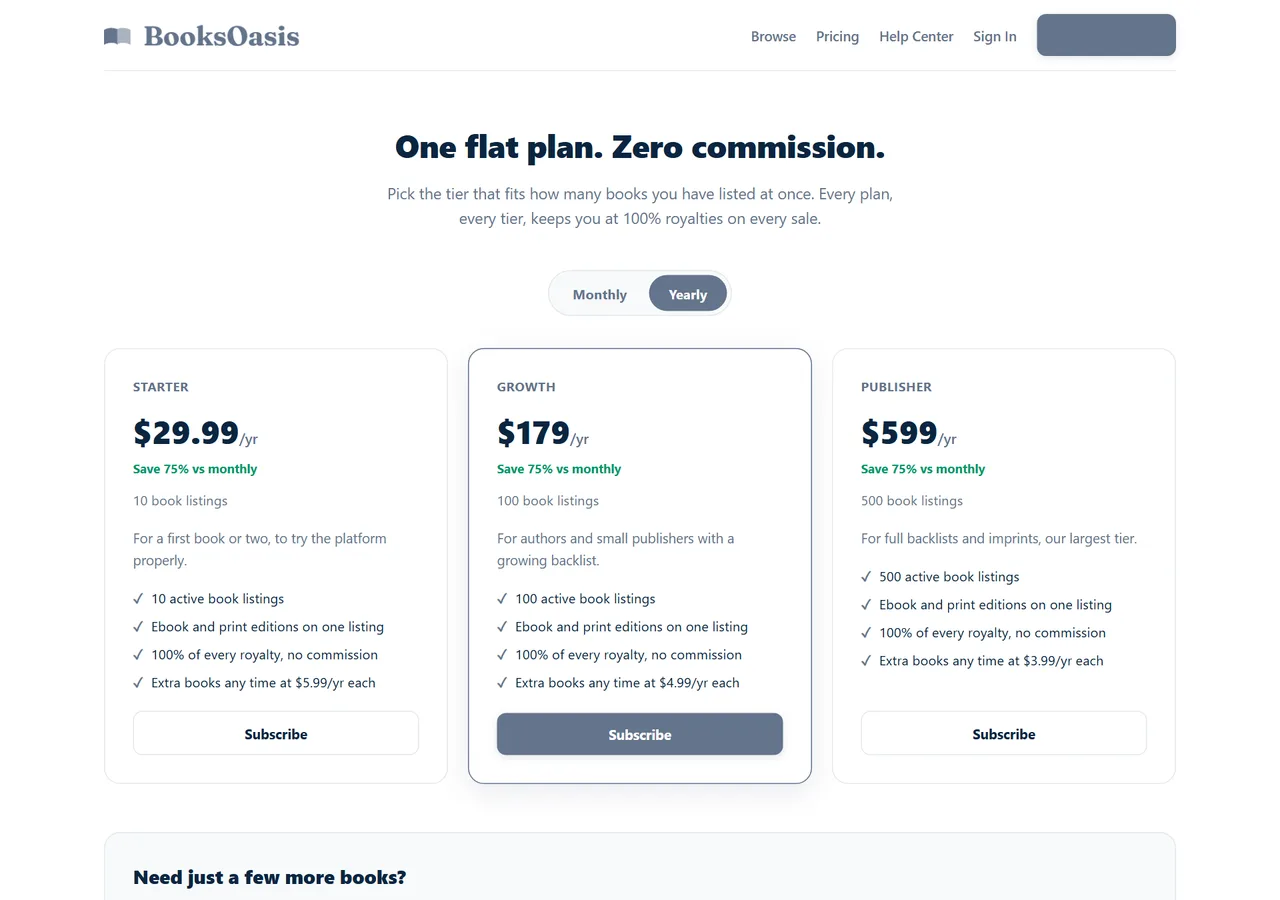
Pricing freedom on BooksOasis
- 100% of the ebook price at any price, with no bands and no delivery costs.
- Promotional prices with start and end dates, shown against the regular price.
- Ebook, paperback and hardcover each priced separately on one listing.
Good to know: print editions can't be priced below their printing cost plus the 30% handling fee, so every print sale earns you something.
See plans and pricingIn short
Price like successful books in your genre, stay between $2.99 and $12.99 if Amazon matters (and at $2.99 or more for Kobo), use a lower first book to open a series, keep ebooks clearly cheaper than print, and test. On stores without bands, you are free to price exactly where your book belongs.
Questions
What is a good price for an ebook?
Many indie novels sell between $2.99 and $6.99, with longer books, box sets and non-fiction higher. The right price depends on your genre, length and how well known you are.
Why do so many ebooks cost $2.99?
Because $2.99 is the lowest price that earns 70% at Amazon and Kobo. Below it, both pay a lower rate.
Should my first book be cheap?
Often, especially as the first in a series. A lower price or a limited-time promotion lowers the risk for new readers, who then buy the rest at full price.
What is the highest price for the 70% royalty on Amazon?
On Amazon.com, $12.99, from July 7, 2026. Above that, KDP pays 35%.
Should an ebook cost less than the paperback?
Yes, readers expect that. Ebooks have no printing cost, and a clear gap between formats looks fair.
Should I price the same on every store?
Generally yes. Consistent prices are fair to readers and avoid Amazon matching a lower price found elsewhere, which would reduce your royalty there.
How often should I change my ebook price?
Rarely without a reason. Change prices to test, to run a time-limited promotion, or when you release a new book in a series, then give each change a few weeks to show results.
Does a higher price make a book look better?
Up to a point. A price in line with successful books in your genre signals quality; a price far above them usually just reduces sales unless readers already know your work.
Can I set different prices in different countries?
Yes. Most stores let you set a price per country or convert from your US price. Check that each local price is inside that store's royalty band for that currency.
What price should a box set be?
Usually well below the combined price of the books, often around the price of two, so readers see a clear saving. On Amazon.com, staying at $12.99 or below keeps the 70% rate.
Is /usr/bin/bash.99 a good price for an ebook?
It can work for short stories or a first-in-series promotion, but on Amazon and Kobo it earns the lower royalty rate. For most full-length books it signals low value if used permanently.
Do price bands apply on BooksOasis?
No. On BooksOasis you keep 100% of the ebook price at any price, with no bands and no delivery costs.
Price freely, keep 100%
No price bands on BooksOasis: every ebook sale pays its full price.