"How much do authors make per book?" is one of the most searched questions in publishing, and most answers are either vague or out of date. This guide gives real numbers, using 2026 royalty terms, with worked examples you can adapt to your own books.
Ebook earnings per copy
Ebooks have no printing cost, so earnings are a share of the price. Here is what one sale earns at common prices:
| Platform | $0.99 | $2.99 | $4.99 | $9.99 |
|---|---|---|---|---|
| BooksOasis | $0.99 | $2.99 | $4.99 | $9.99 |
| Apple Books | $0.69 | $2.09 | $3.49 | $6.99 |
| Barnes & Noble Press | $0.69 | $2.09 | $3.49 | $6.99 |
| Kobo Writing Life | $0.45 | $2.09 | $3.49 | $6.99 |
| Amazon KDP (1 MB file) | $0.35 | $1.94 | $3.34 | $6.84 |
| Via Draft2Digital | $0.59 | $1.79 | $2.99 | $5.99 |
Example calculations with 2026 terms. Kobo pays 45% below $2.99; KDP pays 35% below $2.99 on Amazon.com.
Paperback earnings per copy
Print books subtract a printing cost from every sale, so earnings depend on page count and trim size as well as price.
| Scenario (printing cost $5.00) | List price | You earn |
|---|---|---|
| KDP on Amazon.com (60%) | $15.00 | $4.00 |
| KDP on Amazon.com (60%) | $16.99 | $5.19 |
| KDP Expanded Distribution (40%) | $16.99 | $1.80 |
| Trade distribution at 55% discount | $16.99 | About $2.33 |
| BooksOasis direct | $16.99 | $10.49 |
Illustrative, using the same printing cost for comparison. On BooksOasis, the printing cost and a handling fee of 30% of that cost come out first; readers pay shipping.
Hardcover earnings per copy
Hardcovers sell at higher prices but cost much more to print, and printing costs rose in 2026. A hardcover might sell for $24.99 to $29.99 and cost $10 or more to print, leaving earnings similar to or only a little higher than a paperback on retail channels. Hardcovers shine as gifts and keepsakes, and when sold directly, where no retailer discount applies.
Self-publishing vs traditional publishing, per book
| Format | Self-published (typical) | Traditional (typical) |
|---|---|---|
| $4.99 ebook | $3.34 to $4.99 | About 25% of the publisher's net receipts, often under $1 |
| $16.99 paperback | About $2 to $10 depending on channel | About 7.5% to 10% of list, roughly $1.27 to $1.70 |
| Advance | None | Often, earned out before further royalties |
| Production costs | You pay | Publisher pays |
Traditional figures are common industry ranges; contracts vary.
Per copy, self-publishing usually pays more. Traditional publishing offers an advance, professional production and wider print distribution in exchange.
What affects how much you make
Price and price bands
Staying inside retailers' 70% bands (on Amazon.com, $2.99 to $12.99) matters more than any other single choice for ebooks.
Format
Ebooks have no unit cost; print books do. Many indie authors earn most from ebooks, while print adds income and credibility.
Platform
Retailers keep around 30%; aggregators take a little more; flat-fee stores take nothing per sale on ebooks.
Series vs standalones
A reader who enjoys book one of a series often buys the rest. Series multiply income from each reader you win.
Kindle Unlimited
For authors in KDP Select, page reads can be a large share of income, paid from a monthly fund that varies.
Promotions
Discounts earn less per copy but can multiply sales and bring readers to your other books.
Realistic yearly scenarios
Here is what different sales levels mean at about $3 earned per book, a common average across ebooks and print for indie authors.
| Books sold a year | Yearly earnings at about $3 a book | Roughly per month |
|---|---|---|
| 100 | $300 | $25 |
| 1,000 | $3,000 | $250 |
| 5,000 | $15,000 | $1,250 |
| 10,000 | $30,000 | $2,500 |
| 25,000 | $75,000 | $6,250 |
Before expenses and taxes. Illustrative only.
These numbers show why catalog size matters. Selling 10,000 books a year from one title is rare; from ten titles, it is 1,000 each.
Kindle Unlimited earnings
For books in KDP Select, a borrow isn't paid per copy but per page read, from a monthly fund whose per-page rate changes every month and is a fraction of a cent. A full read of a 300-page novel therefore earns a small amount that varies month to month. For fast readers of long series, those amounts add up to a large share of some authors' income; for others, they are modest. Check your own KDP reports rather than relying on averages.
How genre changes the picture
| Genre type | Typical pattern |
|---|---|
| Romance, thrillers, fantasy | Lower ebook prices, high volume, series and Kindle Unlimited readers |
| Literary fiction | Fewer, slower sales; print and prizes matter more |
| Non-fiction and how-to | Higher prices, steady long-term sales, strong print |
| Devotional and faith | Series and daily-reading formats; print gifts sell well |
| History and biography | Higher prices, strong print and library interest |
Price your books like the successful books in your genre, then work out what each platform pays at that price.
Earnings over a book's lifetime
Unlike a traditionally published book that may go out of print, a self-published book can sell for as long as you keep it listed. Sales are usually highest at launch, then settle to a steady trickle, lifted by promotions, new releases in the series and seasonal interest. A book selling 20 copies a month for ten years sells 2,400 copies. Small per-copy differences, such as keeping 100% rather than 70%, compound over that lifetime.
Audiobooks and other formats
Many indie authors add audiobooks, which open a new audience but carry production costs for narration. Some add large-print editions, box sets or translations. Each format is another way to earn from the same story, and another place readers can find you.
When the money arrives
Retailers usually pay monthly, some weeks after the month ends; KDP pays about 60 days after the end of the month of sale. On BooksOasis, each sale is recorded in your earnings ledger as it happens, and payouts go by bank transfer or PayPal, with international wires once your balance passes a minimum. Plan your cash flow around these delays, especially around launches and advertising.
The costs to subtract
Earnings per book aren't profit. Self-published authors typically pay for some of these:
- Editing, from proofreading to developmental editing.
- Cover design, often the most important sales investment.
- Formatting, free with some tools, paid with others.
- ISBNs, depending on your country.
- Advertising and promotion.
- Platform fees, such as flat plans or account fees.
A book that earns $3 a copy and cost $1,500 to produce needs 500 sales to break even.
Why most authors earn less than they expect
The honest truth is that most self-published books sell modestly. The authors who earn well usually share a few habits: they publish regularly, write in series, invest in covers, understand their genre's pricing, build a mailing list, and treat promotion as part of the job. None of these are secrets, but they take time. Knowing your per-book earnings is the starting point for planning all of them.
How to earn more per book
- Price within the 70% bands at retailers.
- Price paperbacks at $9.99 or more on Amazon.com, if your market allows, for the 60% rate.
- Write in series so each reader buys several books.
- Sell direct to readers who know you, where you keep more.
- Add a flat-fee store so the sales you win there keep their full price.
- Keep ebook files small to reduce Amazon delivery costs.
- Offer hardcovers for readers who want them, especially as gifts.
Where BooksOasis fits
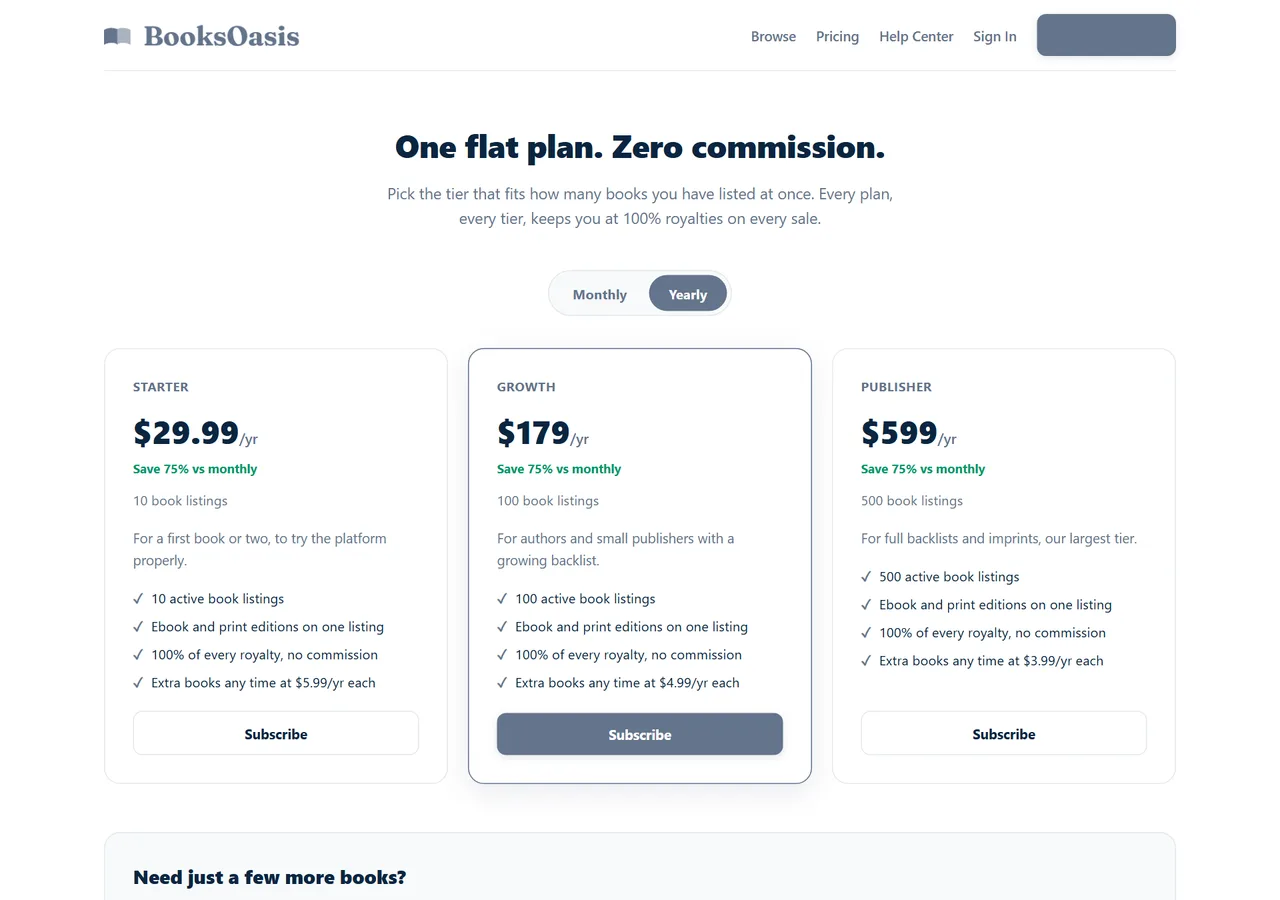
Earning more per book on BooksOasis
- 100% of the ebook price on every sale, for a flat plan from $29.99 a year.
- Print editions at printing cost plus a 30% handling fee on that cost; readers pay shipping.
- Ebook, paperback and hardcover on one listing.
What it doesn't do: BooksOasis doesn't distribute to other stores. Use it alongside retailers to lift your average earnings per book.
See plans and pricingA worked example: one author, one year
Consider an author with a four-book series, selling 2,000 ebooks and 300 paperbacks in a year:
| Where | Sales | Earnings per copy | Total |
|---|---|---|---|
| Amazon ebooks at $4.99 | 1,400 | $3.34 | $4,676 |
| Other retailers at $4.99 | 400 | $3.49 | $1,396 |
| BooksOasis ebooks at $4.99 | 200 | $4.99 | $998 |
| Amazon paperbacks at $15 | 300 | $4.00 | $1,200 |
| Total before expenses | $8,270 | ||
Illustrative figures. BooksOasis plan cost ($29.99 a year) not subtracted.
Moving just 200 sales to a full-margin store adds about $300 compared with selling those copies at a retailer's 70%.
Sources
Checked September 2026: KDP ebook list prices; KDP paperback royalty; Kobo Writing Life; B&N Press; Draft2Digital; Apple Books for Authors.
In short
Per book, self-published authors earn roughly $2 to $3.50 on a typical ebook at retailers, the full price on flat-fee stores, and a few dollars on a paperback after printing. The real difference in income comes from how many books you write, how many readers find them, and how much of each sale you keep. Price inside the bands, write in series, and add stores where you keep more.
Questions
How much does a self-published author make per ebook?
Usually between $1.94 and $3.49 on a $2.99 to $4.99 ebook at major retailers paying 70%, and the full price on a flat-fee store like BooksOasis. Ebooks priced below $2.99 on Amazon earn 35%.
How much does a self-published author make per paperback?
It depends on list price and printing cost. On Amazon.com, a paperback priced at $9.99 or more earns 60% of list minus printing; a $15 book costing $5.00 to print earns about $4.00.
How much do traditionally published authors make per book?
Typically around 25% of net receipts on ebooks and roughly 7.5% to 15% of list price on print, often against an advance. Per copy, that is usually less than self-publishing, but the publisher pays production costs.
How many books do I need to sell to make a living?
It depends on your price and platforms, but at around $3 profit per book, earning $30,000 a year takes about 10,000 sales. Most full-time indie authors reach that with several books in a series.
What earns more, ebooks or paperbacks?
Per copy, a paperback often earns more dollars because its price is higher, but ebooks cost nothing to produce per copy and usually sell in larger numbers for indie authors.
Do self-published authors get advances?
No. Self-published authors are paid royalties as books sell. In exchange, they keep a much larger share of each sale and control their rights and prices.
How much does it cost to self-publish a book?
It can range from almost nothing, if you do most work yourself, to several thousand dollars for professional editing, cover design and marketing. Many authors prioritise a professional cover and at least a proofread.
Is it better to price low to sell more?
Sometimes. A lower price can increase sales and reach, especially for a first book in a series. But below .99 many retailers pay a lower royalty rate, so check the numbers before pricing very low.
How much do BooksOasis authors earn per ebook?
The full ebook price. BooksOasis takes no commission and no processing cut from your ebook royalty; you pay a flat plan instead.
Do I pay tax on book royalties?
Usually, yes. Royalties are generally taxable income where you live. Keep records of every payout and expense, and check your local rules or ask a tax professional.
Which platform pays authors the most per book?
Per ebook sale, flat-fee stores such as BooksOasis pay the most, at 100% of the price. Among retailers, Apple Books and Barnes & Noble Press pay 70% at almost any price.
Do print books or ebooks sell more for indie authors?
For most indie fiction, ebooks sell more copies. Non-fiction, children's books and gift books often sell more in print.
Earn more from every ebook
Keep 100% of the ebook price on BooksOasis.