Every author who decides not to be exclusive to Amazon faces the same question: upload to each store yourself, or let a distributor do it? Both approaches work, and neither is always better. The trade-off is money against time, with some important details around promotions, libraries and control.
What each approach means
| Going direct | Using an aggregator | |
|---|---|---|
| Accounts | One per store | One |
| Uploads | Once per store | Once |
| Royalty at 70% stores | About 70% | About 60% |
| Payments | Separate from each store, on each store's schedule | One combined payment |
| Reach | Stores that accept authors directly | Those stores plus smaller retailers and libraries |
| Store promotions | Available at some stores | Often limited |
| Price changes | Update each store | Update once |
| Fees | None to publish | A share of sales; Draft2Digital also has small account fees since 2026 |
The money, in numbers
Here's what a year of sales at retailers paying 70% looks like direct versus through an aggregator keeping about 10% of the retail price.
| Ebook price and yearly sales | Direct (70%) | Aggregator (about 60%) | Difference |
|---|---|---|---|
| $4.99 × 100 | $349.30 | $299.40 | $49.90 |
| $4.99 × 1,000 | $3,493.00 | $2,994.00 | $499.00 |
| $4.99 × 5,000 | $17,465.00 | $14,970.00 | $2,495.00 |
| $9.99 × 1,000 | $6,993.00 | $5,994.00 | $999.00 |
Example calculations for retailers such as Kobo (70% from $2.99 if the ebook is 20% below print), Apple (70% at all prices) and Barnes & Noble (70% from $0.99). Amazon isn't included, because most authors publish there directly through KDP either way.
At 100 sales a year, going direct is worth about $50: probably not worth an evening of setup and ongoing admin. At several thousand sales, it's worth thousands.
The time, honestly
The extra royalty comes at a cost in hours. Going direct means, for each store:
- Creating and verifying an account, including tax and bank details.
- Uploading files, covers, descriptions, keywords and categories.
- Updating prices separately for every promotion.
- Reading separate sales reports and reconciling separate payments.
- Uploading a new file everywhere when you fix a typo.
With five stores and ten books, that adds up. An aggregator turns most of it into one task.
A simple way to value your time
Suppose one direct account costs you about two hours to set up and an hour a month to maintain: price changes, new files, reports. That's roughly 14 hours in the first year. If going direct with that store earns you an extra $499 a year (1,000 sales at $4.99), you're paid about $36 an hour for the admin. At 100 sales a year, it's closer to $3.50 an hour, and the aggregator is the better deal. Run your own numbers before deciding, using your real sales and a realistic estimate of your own time.
What aggregators do that you can't
- Library platforms. Many library distributors don't accept individual authors; aggregators can reach them.
- Smaller and international stores that would never be worth a separate account.
- Free tools such as formatting and universal book links, depending on the aggregator.
- One payment, which simplifies bookkeeping.
What going direct gives you
- About 10 more points per sale at the big wide stores.
- Promotions: some stores offer merchandising opportunities mainly to direct authors, such as Kobo's promotions area.
- Faster changes: price updates and new files go live without passing through a middleman.
- Direct data from each store's own dashboard.
- A direct relationship with each store's author support team.
The hybrid setup most wide authors use
| Store | How | Why |
|---|---|---|
| Amazon | KDP direct | Largest market; aggregators add a cut |
| Your one or two biggest wide stores | Direct | Most of your wide income, plus promotions |
| Other retailers | Aggregator | Not worth separate accounts |
| Libraries | Aggregator | Often not open to authors directly |
| BooksOasis | Direct listing | Keep 100% of the ebook price on sales there |
The rule that keeps this safe: never deliver the same book to the same store twice. If you go direct with Kobo, switch Kobo off in your aggregator for that book.
When to start with an aggregator
- You have one to three books.
- You're still learning how each store works.
- You want libraries and smaller stores from day one.
- Your time is better spent writing the next book.
When to go direct
- One store brings a large share of your wide income.
- You want that store's promotions.
- You change prices often for promotions and want changes to go live quickly.
- Your sales are high enough that 10 points is real money.
Moving a book from aggregator to direct
- Pick one book and one store to test.
- Check with the store whether reviews and ranking can carry over, especially for a book that sells well.
- Use the same ISBN if the book has one.
- Set up the direct listing, then switch that store off in your aggregator.
- Watch for a gap where the book is briefly unavailable, and avoid moving during a promotion.
What about print?
The same question applies to paperbacks and hardcovers. KDP Print covers Amazon directly. For bookstores and libraries, a print distributor such as IngramSpark makes your book orderable through the wider trade, and some aggregators now offer print too. Barnes & Noble Press prints for its own store, with a $14.99 minimum print price since May 2026. Most authors use KDP Print for Amazon plus one wider print option, rather than setting up print on every platform. See KDP vs IngramSpark.
Common mistakes
- Double delivery: sending the same book to a store directly and through an aggregator, which can create duplicate listings.
- Going direct everywhere too early, then struggling to keep prices and files in sync.
- Forgetting libraries when leaving an aggregator entirely.
- Judging a store after a month. Wide sales usually take several months to build.
- Moving a best-seller mid-promotion, when a brief gap in availability costs the most.
Questions to decide your setup
- Where do your sales come from?Check the last six months by store.
- What is 10 points worth at those stores?Multiply yearly revenue there by 0.10.
- What is your time worth?Estimate the hours a direct account costs you each month.
- Do you want that store's promotions?Some are only available to direct authors.
- Do libraries matter in your genre?If yes, keep an aggregator for them.
If the second answer is bigger than the third, go direct with that store. Repeat the exercise for the next store once a year, as your sales and catalogue grow.
Aggregators compared briefly
Draft2Digital is the most widely used, and now owns the Smashwords Store. It keeps about 10% of retail price and, since 2026, charges new accounts a $20 activation fee and a $12 yearly fee unless you earned $100 or more in the previous twelve months. Other aggregators exist with different fee models and store lists; compare them on what share they keep at your price, which stores and libraries they reach, and how they pay. See Draft2Digital alternatives.
A store that isn't either
BooksOasis is an independent bookstore for ebooks, paperbacks and hardcovers. It isn't a retailer that takes a percentage, and it isn't an aggregator. You list directly and pay a flat yearly plan, keeping 100% of your ebook price with no processing cut. Print editions are printed on demand: you earn the price minus printing and a 30% handling fee on that cost.
| $4.99 ebook | Direct retailer | Via aggregator | BooksOasis |
|---|---|---|---|
| Per sale | $3.49 | $2.99 | $4.99 |
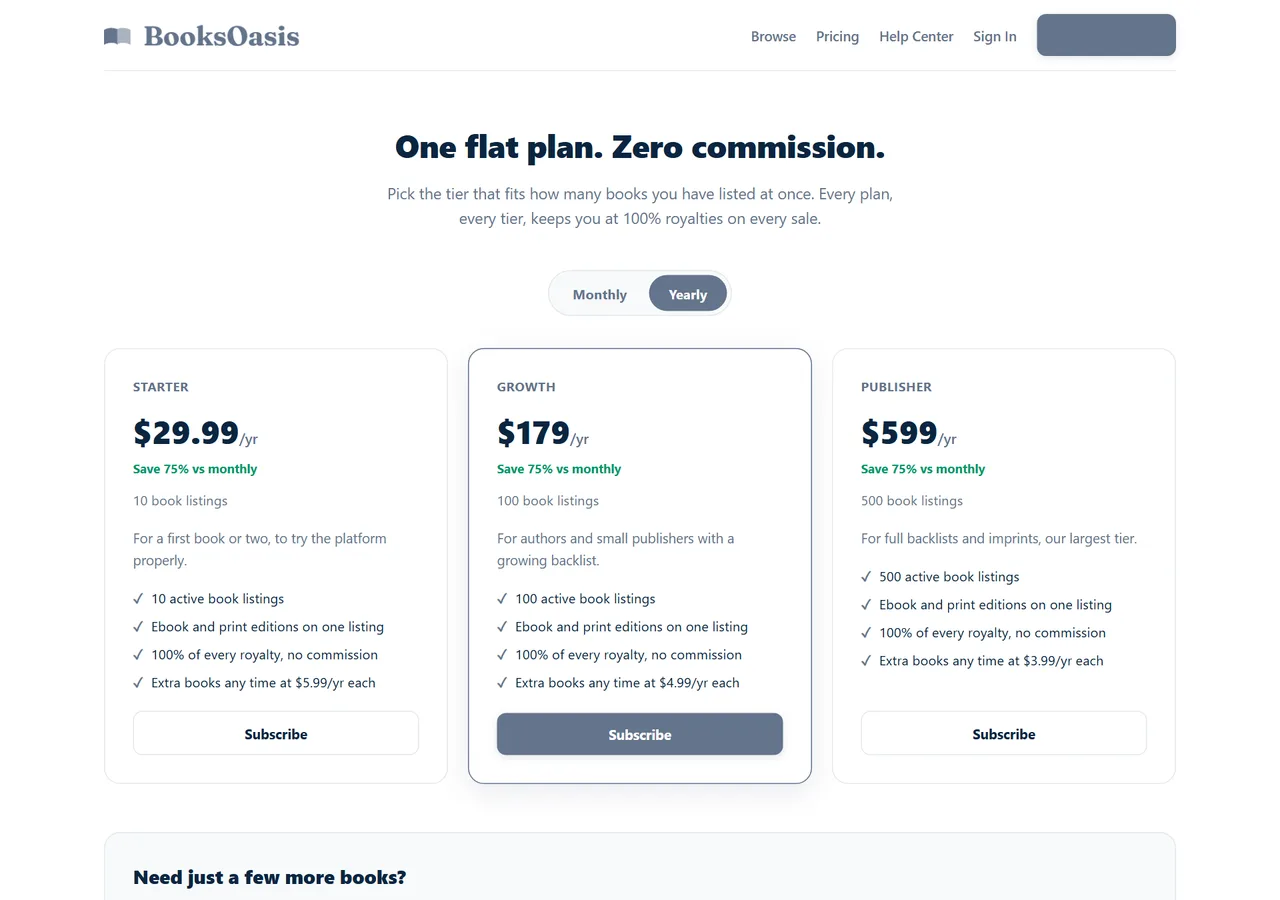
BooksOasis plans start at $29.99 a year for 10 books; see flat plan break-even.
What BooksOasis does not do
- It doesn't distribute to other stores or libraries.
- It isn't compatible with KDP Select ebook exclusivity, like any other store.
- Its plan costs a flat fee whether or not you sell.
Three authors, three setups
A debut author with two novellas uses an aggregator for everything outside Amazon, and spends the saved time writing book three.
A cozy-mystery author selling thousands of ebooks a year on Apple went direct with Apple and Kobo, kept the aggregator for libraries and small stores, and now applies for Kobo promotions every quarter.
A non-fiction author with a large newsletter publishes direct on KDP, uses an aggregator for wide stores, and sends newsletter readers to BooksOasis for launch-week sales where he keeps the full price.
Sources
Checked September 2026: Draft2Digital royalty rates; ALLi on Draft2Digital's 2026 fees; Kobo Writing Life agreement; B&N Press.
In short
An aggregator buys you time and reach for about 10 points of royalty; going direct buys you money and promotions for your time. Start with an aggregator, go direct with your biggest stores as sales grow, keep libraries and small stores with the aggregator, and add a direct store like BooksOasis where every ebook sale is 100% yours.
Questions
What is an ebook aggregator?
A service that delivers your book to many retailers and library platforms from one upload and one dashboard, and pays you from a single account. Draft2Digital is the best-known example. In exchange it keeps a share of each sale.
How much does an aggregator cost?
Draft2Digital keeps about 10% of the retail price, so a retailer paying 70% becomes about 60% for you. Since 2026 it also charges new accounts a $20 activation fee and a $12 yearly fee unless you earned $100 or more in the previous twelve months.
How much more do I earn going direct?
About 10 percentage points per sale at retailers such as Kobo, Apple and Barnes & Noble. On 1,000 sales of a $4.99 ebook a year, that's about $499.
Is it worth going direct as a new author?
Often not at first. With one or two books and few sales, the time spent on several dashboards may be worth more than the extra royalty. Many authors start with an aggregator and go direct as sales grow.
Can I use an aggregator and go direct at the same time?
Yes, and most wide authors do. Go direct with your biggest stores and let the aggregator handle the rest. Just never send the same book to the same store twice.
Do aggregators reach Amazon?
Some can deliver to Amazon, but most authors publish on Amazon directly through KDP, which pays more.
Do aggregators reach libraries?
Yes. Library platforms are one of the main reasons to use an aggregator, since many aren't open to individual authors directly.
Will I lose reviews if I switch from aggregator to direct?
Sometimes. A book removed from one channel and republished may appear as a new listing. Using the same ISBN helps; check with the store before moving a book that sells well.
Do I get promotions going direct?
Some retailers offer promotion opportunities mainly to direct authors, such as Kobo's promotions area. That access is one of the less obvious benefits of going direct.
Where does BooksOasis fit?
BooksOasis is a separate store, not an aggregator channel. You list directly, keep 100% of the ebook price for a flat yearly plan, and it works alongside either approach.
Should I use an aggregator for print books?
Most authors use KDP Print for Amazon and one wider print option, such as IngramSpark, for bookstores and libraries. Some aggregators now offer print as well, so compare what each pays at your price.
How do I know which store to go direct with first?
Look at the last six months of sales by store in your aggregator's reports. The store with the most wide revenue is usually the best first candidate, especially if it offers promotions to direct authors.
Add a store where you keep 100%
List on BooksOasis alongside your retailers and aggregator, from $29.99 a year.