Authors look for Kobo Writing Life alternatives for different reasons. Some find sales thin in their genre or country. Some want print. Some want more control over price and readers. And some simply want to be sure they aren't leaving money on the table.
This guide sets out what Kobo pays, where it's strong and weak, and how the alternatives compare, with worked numbers.
What Kobo Writing Life pays
| Situation | Royalty |
|---|---|
| Ebook $2.99 USD or more, at least 20% below every print edition | 70% of list price |
| Ebook below $2.99, or not 20% below print | 45% of list price |
| Public-domain ebook | 20% of list price |
| Audiobook, $2.99 to under $28 | 45% |
| Kobo Plus reads | A share of the Kobo Plus pool, based on minutes read |
Payment arrives monthly, within 45 days after the end of each month. Each currency has its own 70% threshold, so check local prices if you sell in several markets.
The 20% rule most authors miss
Kobo's 70% rate has a condition that isn't obvious: the ebook must be priced at least 20% below every print edition. A $12.99 ebook with a $14.99 paperback is only about 13% cheaper, so it drops to 45%. Price the ebook at $11.99 or less and it qualifies. Check this whenever you change a print price, because raising or lowering the paperback can quietly move your ebook between the two rates.
| Paperback price | Highest ebook price for 70% |
|---|---|
| $9.99 | $7.99 |
| $14.99 | $11.99 |
| $16.99 | $13.59 |
| $19.99 | $15.99 |
What Kobo does well
- No upper price cap on the 70% rate, unlike Amazon's $12.99 limit.
- International readers, with a strong presence outside the US.
- Kobo Plus without exclusivity, so subscription reads don't stop you going wide.
- A promotions dashboard where direct authors can apply for merchandising opportunities.
- No ISBN required and no upfront fee.
Why authors look beyond Kobo
| Reason | What it means |
|---|---|
| Uneven sales | Kobo's audience varies a lot by country and genre |
| No print | Paperbacks and hardcovers need another platform |
| A retailer's cut | Kobo keeps 30% or more of every sale |
| Reader data | Retailers own the customer relationship |
| Discovery | Visibility depends on promotions and your own marketing |
Kobo Writing Life alternatives compared
| Platform | Type | Ebook royalty | Best for |
|---|---|---|---|
| Amazon KDP | Retailer | 70% from $2.99 to $12.99 on Amazon.com, minus delivery; else 35% | The largest ebook market |
| Apple Books | Retailer | 70% at all prices | iPhone and iPad readers |
| Google Play Books | Retailer | 70% in most countries | Android readers worldwide |
| Barnes & Noble Press | Retailer | 70% from $0.99, no upper band | US readers, plus print |
| Draft2Digital | Aggregator | About 60% at most stores | Reaching many stores from one dashboard |
| BooksOasis | Flat-fee store | 100% of the ebook price | Keeping every dollar of the sales you win there |
What you'd earn per sale
| Ebook price | Kobo (direct) | KDP (1 MB) | Apple or B&N | Via Draft2Digital | BooksOasis |
|---|---|---|---|---|---|
| $0.99 | $0.45 | $0.35 | $0.69 | $0.59 | $0.99 |
| $2.99 | $2.09 | $1.94 | $2.09 | $1.79 | $2.99 |
| $4.99 | $3.49 | $3.34 | $3.49 | $2.99 | $4.99 |
| $9.99 | $6.99 | $6.84 | $6.99 | $5.99 | $9.99 |
| $14.99 | $10.49 | $5.25 | $10.49 | $8.99 | $14.99 |
Example calculations, assuming the Kobo ebook is priced at least 20% below print. BooksOasis plans cost a flat yearly fee (from $29.99), with no commission on ebook sales. Try your own numbers in the royalty calculator.
Amazon KDP
For most authors, KDP is the first companion to Kobo. Amazon is the largest ebook market, and KDP pays 70% from $2.99 to $12.99 on Amazon.com, minus a small delivery charge. Above $12.99 it drops to 35%, which is where Kobo's uncapped 70% pulls ahead.
One decision matters: KDP Select requires ebook exclusivity for 90 days, which means leaving Kobo. If Kobo sells for you, stay wide. See KDP Select vs wide.
Apple Books and Google Play Books
Apple pays 70% at every price, so it's generous for both $0.99 promotions and premium-priced books. Google Play pays 70% in most countries. Both reach huge numbers of phone readers, and both can be reached directly or through an aggregator.
Barnes & Noble Press
B&N Press pays a flat 70% on ebooks from $0.99 with no upper band, and also offers print. Its audience is concentrated in the US, which makes it a natural partner to Kobo's international strength.
Draft2Digital
If managing five dashboards sounds exhausting, an aggregator like Draft2Digital delivers to Kobo, Apple, Barnes & Noble and many smaller stores and libraries, keeping about 10% of the retail price. You lose some royalty and direct access to Kobo's promotions, but save time. More in Draft2Digital alternatives.
BooksOasis: a store where you keep 100%
BooksOasis is an independent bookstore for ebooks, paperbacks and hardcovers. Instead of taking a percentage, it charges publishers a flat yearly plan, and you keep 100% of your ebook price on every sale there, with no processing cut.
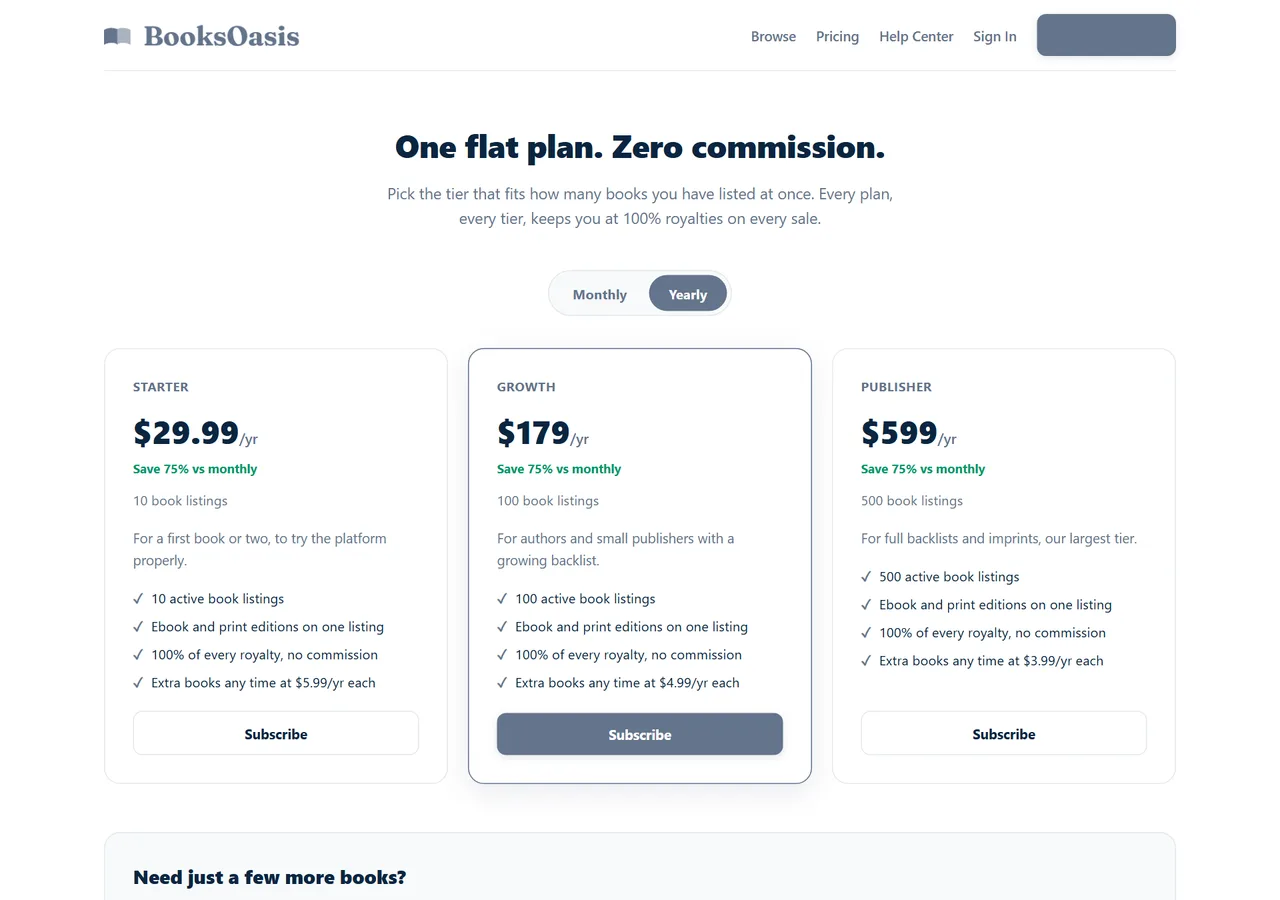
| Plan | Price | Books |
|---|---|---|
| Starter | $29.99 a year (or $9.99 a month) | 10 |
| Growth | $179 a year | 100 |
| Publisher | $599 a year | 500 |
- Print too: paperbacks and hardcovers are printed on demand; you earn the price minus printing cost and a 30% handling fee on that cost, and the reader pays shipping.
- Your own promo prices with start and end dates.
- Unlimited pen names and imprints.
- No exclusivity: keep selling on Kobo and everywhere else.
What BooksOasis does not do
- It doesn't distribute your book to Kobo, Amazon or other retailers; it's one more store.
- It has no subscription program like Kobo Plus.
- Its plans cost a flat fee whether you sell or not, so it pays off once you make a few sales a year.
How many sales cover the plan? See flat plan break-even.
Kobo Plus: worth enrolling?
Kobo Plus is Kobo's subscription service. Enrolled ebooks earn from a pool based on the minutes subscribers spend reading them, and enrolment is optional and non-exclusive. That's the key difference from Kindle Unlimited, which requires your ebook to be exclusive to Amazon. For long books and series in popular genres, Kobo Plus reads can add up; for short or niche books, sales matter more. Many wide authors enrol and watch the numbers for a few months.
Switching from an aggregator to Kobo direct
If you currently reach Kobo through an aggregator, moving direct raises your share by about 10 points and opens Kobo's promotions dashboard. The risk is that a book removed from one channel and republished may appear as a new listing, losing its reviews. Use the same ISBN, move one book first, and check with Kobo's support team before moving a book that sells well.
Three authors, three setups
A Canadian romance author sells most on Kobo, stays direct there, enrols in Kobo Plus, and uses KDP without Select so her books stay wide.
A US thriller writer earns most on Amazon, keeps Kobo through an aggregator to save time, and sends newsletter readers to BooksOasis for launch-week sales where he keeps the full price.
A non-fiction author with $16.99 ebooks finds Kobo, Apple and B&N pay far more per copy than Amazon's 35% above $12.99, and prices the paperback at $21.99 to keep Kobo's 20% rule.
A sensible wide setup around Kobo
- Stay direct on Kobo.Keep the 70% rate and the promotions dashboard.
- Add KDP for Amazon.Stay out of KDP Select so you can remain wide.
- Go direct where you sell most.Apple, Google Play or B&N Press, depending on your readers.
- Use an aggregator for the rest.Smaller stores and libraries.
- Add a direct store.Send your newsletter and social readers to a store where you keep 100%.
Pricing across Kobo and the others
- Keep ebooks at least 20% below print for Kobo's 70% rate.
- Stay at $12.99 or below if Amazon matters, because KDP drops to 35% above it.
- Use $0.99 promotions carefully: Kobo pays 45% and KDP 35% at that price, while Apple and B&N still pay 70%.
- Price consistently across stores to avoid price-matching surprises.
More in how to price an ebook.
Who should stay focused on Kobo
- Authors whose readers are strong in Kobo's markets.
- Authors who benefit from Kobo Plus reads.
- Authors selling premium-priced ebooks above $12.99.
Who should widen beyond Kobo
- Authors with most readers in the US, where Amazon and B&N dominate.
- Authors who need print.
- Authors building a newsletter who want a store where they keep every dollar.
Sources
Checked September 2026: Kobo Writing Life service agreement; KDP ebook royalties; B&N Press; Draft2Digital royalty rates.
In short
Kobo Writing Life pays well, with 70% from $2.99 and no upper cap, provided your ebook is 20% below print. Rather than replacing it, most authors build around it: KDP for Amazon, direct accounts where readers are, an aggregator for the rest, and a direct store like BooksOasis where every ebook sale is 100% yours.
Questions
What royalty does Kobo Writing Life pay?
According to Kobo's service agreement, 70% of the list price for ebooks priced at $2.99 USD or more and at least 20% below every print edition; otherwise 45%. Public-domain ebooks earn 20%.
Is there an upper price limit for Kobo's 70% rate?
Kobo's agreement sets a minimum price of $2.99 USD for 70% and a requirement to price the ebook at least 20% below print. It does not set an upper limit the way Amazon does.
When does Kobo pay?
Kobo pays monthly, within 45 days after the end of the month in which the sales happened.
Is Kobo Plus exclusive?
No. Enrolling ebooks in Kobo Plus is optional and doesn't stop you selling elsewhere.
What is the best alternative to Kobo Writing Life?
There isn't a single replacement, because Kobo reaches its own readers. Most wide authors add KDP, Apple Books, Google Play and Barnes & Noble Press directly, use an aggregator for smaller stores, and add a direct store such as BooksOasis where they keep 100% of the ebook price.
Should I use Draft2Digital to reach Kobo instead of going direct?
Going direct pays about 10 percentage points more, and gives you access to Kobo's own promotions dashboard. An aggregator saves time if you publish on many stores.
Does Kobo sell print books from authors?
Kobo Writing Life is focused on ebooks and audiobooks. For print, authors typically use KDP Print, IngramSpark, Barnes & Noble Press or a store that sells print on demand, such as BooksOasis.
Can I list the same ebook on Kobo and BooksOasis?
Yes. BooksOasis doesn't require exclusivity. List your book on both and keep 100% of the ebook price on the BooksOasis sales.
Why do some authors earn little on Kobo?
Kobo's readers are concentrated in certain countries and genres, and discovery depends on promotions and your own marketing. Results vary a lot by genre and region.
Do I need an ISBN for Kobo?
No. Kobo can publish ebooks without an ISBN, though many authors use their own ISBNs across stores.
Does Kobo's 70% rate depend on my paperback price?
Yes. Kobo's agreement requires the ebook to be priced at least 20% below every print edition for the 70% rate. With a $14.99 paperback, an ebook of $11.99 or less qualifies.
Is Kobo better than KDP for premium-priced ebooks?
Often, yes. Above $12.99, KDP pays 35% on Amazon.com, while Kobo keeps paying 70% if the ebook is at least 20% below print. At $14.99 that is about $10.49 on Kobo against $5.25 on Amazon.
Keep 100% on the sales you make here
List on BooksOasis alongside Kobo, from $29.99 a year, no commission.