Mark Twain, George Eliot and George Orwell all wrote under pen names, and today many independent authors run two or three. This guide covers why and when to use one, how to set it up across platforms, and how to manage several without confusion.
Why authors use pen names
| Reason | Example |
|---|---|
| Different audiences | Children's books and adult thrillers under different names |
| Privacy | Keeping writing separate from a day job or family |
| A fresh start | Moving into a new genre without old reviews and expectations |
| Genre conventions | A name that suits the genre's feel |
| Collaboration | Two authors writing under one shared name |
| A hard-to-say legal name | A name readers can spell into a search box |
When one name is better
A pen name isn't free: each name starts from zero readers, zero reviews and zero search history. If your genres share readers, such as mysteries and thrillers, or Christian living and devotionals, one name usually builds a readership faster, because every new book lifts the others. Split names when audiences genuinely don't overlap, or when one audience would be put off by the other.
Choosing a pen name
- Fits the genre. A name that feels right for cosy mysteries may feel wrong on military thrillers.
- Easy to spell and say. Readers need to type it into a search box after hearing it once.
- Not already taken by a well-known author in your genre; search the major stores.
- Available online: check the domain and social handles you'd want.
- Not impersonating anyone: never choose a name designed to be confused with a real author.
- Shelf position: some authors consider where the surname falls alphabetically, though online this matters less.
What stays in your legal name
| Item | Name used |
|---|---|
| Cover, title page, author page | Pen name |
| Platform account | Legal name |
| Tax information and tax interviews | Legal name |
| Bank or payout details | Legal name |
| Contracts with editors, designers, narrators | Legal name (you can note the pen name) |
| Copyright notice | Either; many authors use the pen name |
The platforms know who you are; readers see only the pen name.
Setting up a pen name on each platform
- KDP: enter the pen name in the author field when you set up the book. Amazon's author pages are managed separately; check its current rules on how many author profiles one account can manage.
- Kobo, Apple, B&N Press, Google Play: enter the pen name as the contributor or author name on each book.
- Aggregators: set the author name per book; it passes through to every store.
- BooksOasis: add the pen name as an author profile in your dashboard, then choose it when you list each book.
Use exactly the same spelling everywhere, including middle initials, so stores group the books correctly.
ISBNs and copyright
An ISBN identifies an edition and its publisher, not the author, so a pen name doesn't change how you get ISBNs. If you buy your own, you appear as publisher (or your imprint does), and the pen name appears as author. See ISBNs for self-publishers.
You own the copyright in your work whatever name is on the cover. Some countries let you register copyright for works published under a pseudonym; in the US, the Copyright Office allows pseudonymous registrations. Rules and terms differ by country, so check locally if registration matters to you.
Keeping identities separate
- A bio per name, written for that name's readers.
- Separate author photos or none if privacy matters; many pen names use an illustration or no photo at all.
- A separate email address for reader correspondence.
- Newsletter segments or separate lists, so readers get only what they signed up for.
- Consistent branding within each name: typography, cover style, tone of voice.
- Careful back matter: "Also by" lists should include only that name's books, unless you've chosen to connect names publicly.
Marketing several names
Every pen name is effectively a separate small business. Be honest about how many you can sustain. A common pattern is one main name that gets most of the marketing effort and a second name for a side genre that grows more slowly. Two well-supported names usually do better than four neglected ones.
Websites for pen names
Each pen name benefits from a simple home online: a one-page site with the books, a newsletter sign-up and links to stores. If privacy matters, register domains with privacy protection so your legal details aren't shown publicly.
Co-writing under a shared name
Two authors can write under one pen name, which keeps the brand simple for readers. Put the business side in writing first: who owns the name, how royalties are split, who controls the account, and what happens if the partnership ends. On most platforms, royalties go to one account holder, who then pays the other.
Moving an existing book to a new pen name
If you've already published under your own name and want to move a book to a pen name, it's possible, but it has costs. On most stores, changing the author name is an edit to the book's details, but some treat a major change as a new book, and reviews and rankings may not carry over. The book's ISBN also ties it to its original metadata in some catalogues. For a book that sells well, it's often better to leave it where it is and start the pen name with new books.
Reviews, advance readers and a new name
A new pen name has no reviews, which makes the first books harder to sell. Build an advance reader group for the new name before launch: readers who get an early copy and are invited to leave honest reviews once the book is out. Never post reviews of your own books under another identity, and never ask friends to review without disclosing the connection where a store requires it.
Three authors, three approaches
A teacher who writes romance uses a pen name to keep her fiction apart from her school life. Her readers know only the pen name, and her payments and tax forms go through her legal name as usual.
A thriller writer who started writing children's books created a second name so parents searching for picture books wouldn't find his violent thrillers, and so thriller readers wouldn't be confused by a picture book on his author page.
A devotional author considered a pen name for a new series on prayer, but kept her own name because her existing readers were exactly the audience, and every new book helped the others.
A setup checklist for a new pen name
- Search the name on major stores, the web and social platforms.
- Register the domain and handles you'll use.
- Create an email address for reader contact.
- Write a bio and choose a photo, illustration or none.
- Set up the author profile on each platform, spelled identically.
- Start a newsletter or segment before the first book launches.
- Plan at least two or three books, since one book rarely builds a new name.
Pen names on BooksOasis
BooksOasis calls a pen name an author profile. One private account can hold as many as you need, with no extra login. Each gets its own public author page listing only its books, and a reader browsing one never sees a link to your other names unless you credit more than one on the same book. Your legal name and account email are never shown to readers.
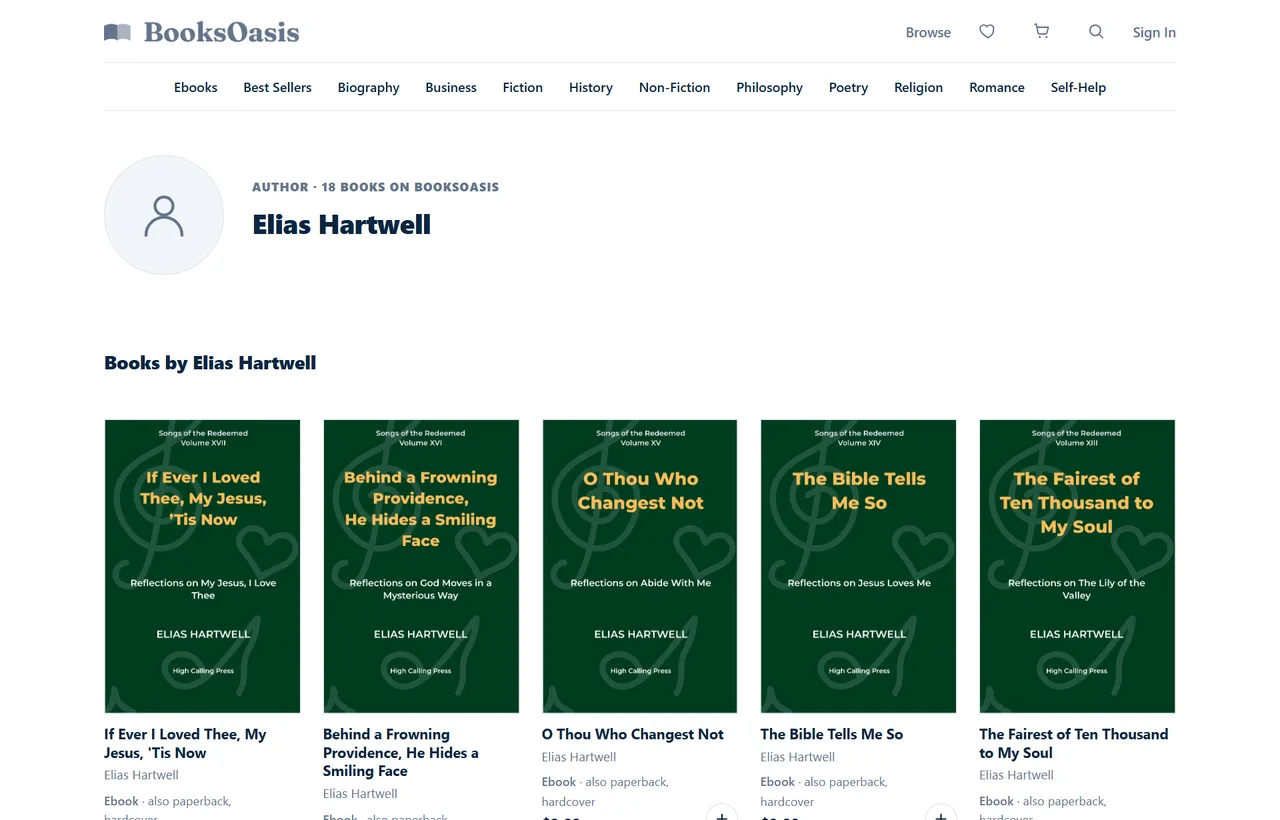
- Unlimited pen names and imprints on every plan.
- One earnings ledger and one payout across all names.
- Publisher profiles for imprints, usable alongside pen names.
- 100% of the ebook price on every sale, for a flat yearly plan.
What BooksOasis does not do
- Plans are counted by books, not names: a Starter plan covers 10 books however many pen names publish them.
- It doesn't set up pen names on other stores for you.
- It doesn't give legal or tax advice about pseudonyms.
Common mistakes
- Too many names too soon, each with too few books to find readers.
- Inconsistent spelling across stores, splitting the author page.
- Cross-linking by accident in back matter or on a shared website.
- Choosing a name too close to an established author's.
- No written agreement for a shared pen name.
Sources
Checked September 2026: BooksOasis: managing multiple pen names; BooksOasis: authors and publisher profiles; US Copyright Office.
In short
A pen name is easy to set up and useful when your audiences don't overlap. Choose a clear, genre-appropriate name nobody else is known by, use it identically everywhere, keep your legal name for the business side, and give each name a bio, a branding style and enough books to find its readers.
Questions
Can I self-publish under a pen name?
Yes. KDP, Kobo, Apple, B&N Press, Draft2Digital and BooksOasis all let you publish under a name other than your legal name. Payments and tax information stay in your legal name.
Is a pen name legal?
Yes. Writing under a pseudonym is common and lawful, provided you're not impersonating a real person or misleading readers about who someone is.
Do I need a separate account for each pen name?
Usually not. Most platforms let one account publish under several author names. On BooksOasis, one account holds unlimited pen names with no extra login.
Will readers see my real name?
Not on your book pages, if you use a pen name. Your legal name appears in private account, tax and payment details. On BooksOasis, your legal name and account email are never shown to readers.
How do I choose a pen name?
Pick something that suits the genre, is easy to spell and remember, isn't already used by a well-known author, and has an available domain and social handles.
Can I copyright a book written under a pen name?
Yes. You own the copyright regardless of the name on the cover. In the US, the Copyright Office allows registration of pseudonymous works; check the rules where you live.
Should I use a pen name for each genre?
Many authors do when genres have very different audiences, such as children's books and adult thrillers. For closely related genres, one name often builds readership faster.
How do I market several pen names?
Give each its own author page, bio, newsletter or newsletter segment, and social presence if you can sustain it. Be realistic: each name needs its own attention.
Can I reveal my pen name later?
Yes. Some authors keep names separate for years and later connect them; others announce a pen name from the start. It's your choice.
What is the difference between a pen name and an imprint?
A pen name is an author identity. An imprint is a publisher name. You can use both: for example, books by several pen names published under one imprint.
Can I move a published book to a pen name?
Often you can edit the author name, but some stores treat a big change as a new book, and reviews may not carry over. For a book that sells well, it's usually better to start the pen name with new books.
Can two authors share a pen name?
Yes. Agree in writing who owns the name, how royalties are split, who controls the accounts, and what happens if the partnership ends.
Do pen names cost extra on BooksOasis?
No. Every plan includes unlimited pen names and imprints. Plans are counted by the number of books, not the number of names.
Run every pen name from one account
Unlimited pen names and imprints on BooksOasis, each with its own author page.