Series are one of the most reliable ways for self-published authors to build a readership. A reader who enjoys book one has a reason to buy book two, and a reason to trust the author with book three. But a series only works if readers can find the next book easily and in the right order. This guide covers the practical steps.
Planning a series
- Decide the shape. A trilogy with one story arc, a long series with continuing characters, or a set of standalones in one world.
- Ordered or unordered? If reading order matters, say so everywhere. If books stand alone, say that too.
- Plan the ending. Readers are more willing to start a series they trust will be finished.
- Write ahead. Having the second book drafted before the first launches keeps the gap between releases short.
- Pick a series name that's distinct and searchable.
Naming and numbering
| Element | Good practice |
|---|---|
| Series name | Identical spelling on every book and store |
| Number | Shown on the cover and in the series field |
| Label | Book, Volume or Part, chosen to fit the genre and used consistently |
| Titles | A shared pattern helps readers spot the set |
| Subtitle or tagline | "Book 2 of the ... series" on the cover or title page |
Put the series details in the series field, not stuffed into the title. Stores use the series field to group books and show reading order; a cluttered title can also break some stores' rules.
Consistent design
- Covers as a family: same title typography, same position for the series name and number, a shared color approach. See ebook cover size.
- Same trim size for every print volume, so they match on the shelf. See book trim sizes.
- Same interior style: fonts, chapter headings and scene breaks.
- Spine design that lines up across the set.
Series metadata on each store
Most stores have a series field and a number field for each book. Filling these in links your books: stores can then show "Book 2 of 5", list the series in order, and point readers to the next title. Enter the series name exactly the same way on every book, and double-check numbers after each release, since a wrong number can scramble the reading order a store shows.
Release schedules
| Approach | How it works | Suits |
|---|---|---|
| Rapid release | Books a few weeks apart at launch | Authors with several books already written |
| Steady cadence | A new book every few months | Most authors writing as they go |
| Complete then release | Whole series written first, released together or closely | Trilogies, slower writers |
Whichever you choose, tell readers when the next book is coming, and use pre-orders where stores allow them, so readers can commit while they're excited.
Back matter that sells the next book
The last page a reader sees is the most valuable real estate in your book. Use it:
- A clear "What's next".The next book's title, cover and a link.
- A short preview.The first chapter of the next book, if you can.
- The series in reading order.A simple numbered list.
- A newsletter invitation.So readers hear when the next book arrives.
- A request for an honest review.Short and polite.
Update the back matter of earlier books when new ones come out, so the links always point somewhere real. A reader who finishes book one a year after release should still find a working link to every later book.
Pricing a series
A common approach is a lower price on book one, to make starting easy, and standard prices on later books, which earn most of the income. Some authors make book one free where a store allows it. Remember each store's price bands: KDP pays 35% below $2.99 on Amazon.com, so a permanently cheap first book costs you royalty there. See series pricing strategy.
Box sets
Once a series (or a run of it) is complete, a box set collects several books in one edition, usually priced well below the total of the individual books. It suits binge readers and makes a strong promotion. Publish it as its own edition with its own cover, and keep the individual books on sale for readers who prefer to start small. Watch price bands here too: a large box set priced above $12.99 earns 35% on Amazon.com, while stores without an upper band pay 70%.
A checklist for each new volume
- Same series name, next number in every store's series field.
- Cover from the series template, with the number visible.
- Description that places the book in the series ("Book 3 of ...") and says whether it stands alone.
- Back matter updated in this book and in every earlier one.
- Newsletter announcement to readers of the earlier books.
- Prices reviewed across the series, including any launch promotion.
Descriptions for series books
Each book's description should work for two readers: someone who has read the earlier books and wants to know what happens next, and someone who has just found this one. State the position in the series early, say plainly whether it can be read on its own, and avoid spoilers for earlier books in the first lines, which appear in search results and previews. See how to write a book description.
Three authors, three series
A fantasy author wrote three books before publishing, released them a month apart, and priced book one lower. Readers who finished book one had book two waiting, which kept them moving through the trilogy.
A cozy-mystery writer publishes a standalone case every four months in an unordered series, so new readers can start anywhere and still find the rest.
A devotional author built a seven-volume series of 30-day devotionals, each on one theme, and labelled them as volumes so readers and small groups could choose any theme and continue through the set.
When a series stalls
If sales drop sharply from book one to book two, look at the join between them. Is the next book clearly linked at the end of book one? Does book one's ending give readers a reason to continue? Is book two's cover and description obviously part of the same series? Small fixes at the join often do more than promoting book one harder.
Series on BooksOasis
On BooksOasis, you create a series from your dashboard and add books to it from each book's listing, either when you first list it or later. You choose whether the series is ordered (with a reading sequence) or unordered (books in the same world or theme, read in any order), and for ordered series the label readers see: Book, Volume or Part.
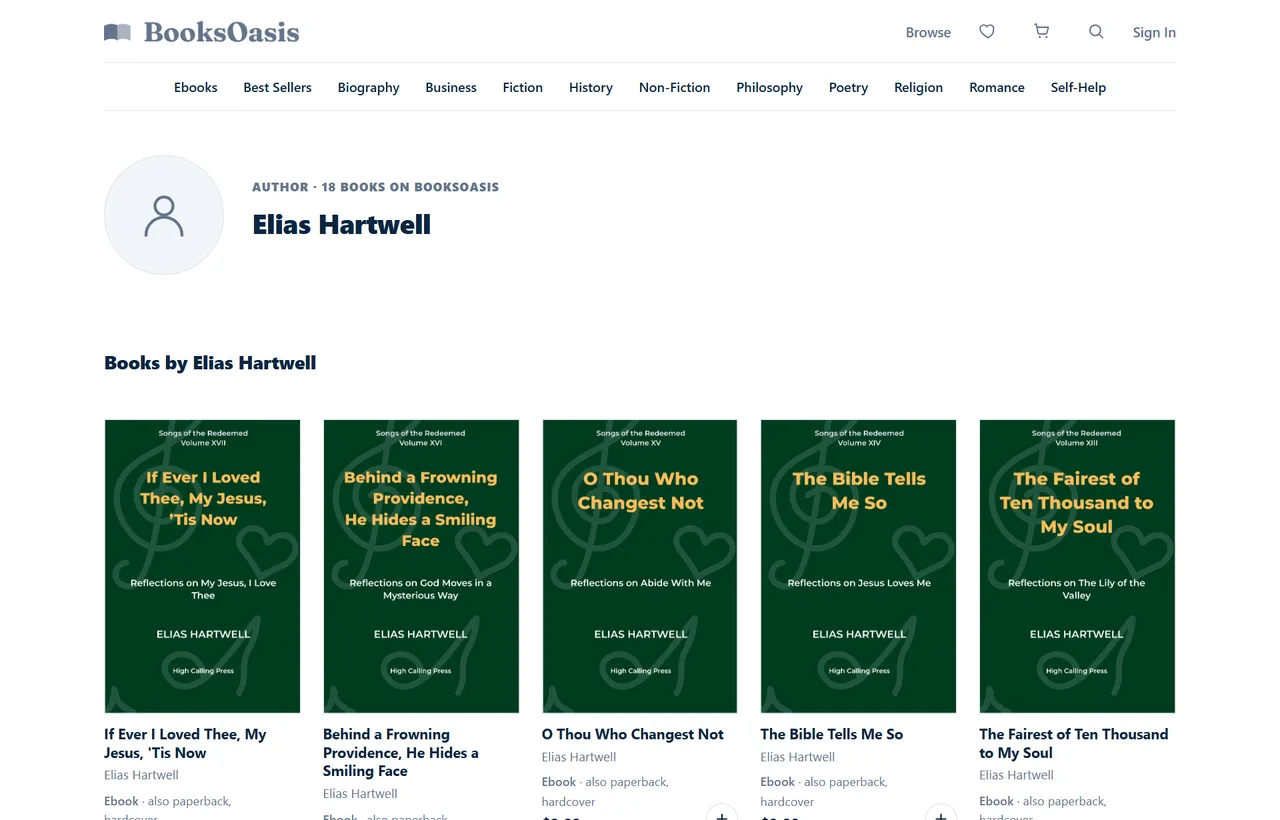
- A series page listing every book in reading order, linked from each book.
- Your own promo prices with start and end dates, for example a launch discount on book one.
- Every format: ebook, paperback and hardcover for each volume.
- 100% of the ebook price on every sale, for a flat yearly plan.
What BooksOasis does not do
- It doesn't discount your series automatically; you run series promotions with your own promo prices and dates.
- It doesn't link your series to other stores' series pages.
- Plans count books, so a long series needs a plan with enough slots.
Running a series promotion
A simple, effective promotion is a limited-time price drop on book one, announced to your newsletter and timed with the release of a new volume. New readers start cheaply, and existing readers are reminded the series continues. On BooksOasis, set it with a promo price and an end date so it switches off automatically.
Common mistakes
- Inconsistent series names across books, so stores don't group them.
- No number on the cover, leaving readers unsure where to start.
- Long gaps between books with no word to readers.
- Dead links in back matter after a book is renamed or moved.
- Changing trim or cover style halfway through a series.
- Series details crammed into the title instead of the series field.
Sources
Checked September 2026: BooksOasis: organizing a series; KDP list price requirements.
In short
Plan the arc, write ahead, and make every book look and read like part of a set. Link books with identical series names and numbers on every store, release on a schedule readers can rely on, and end each book with a clear path to the next. Price the first book as an easy start, add a box set when the series is complete, and give your series a home page that lists it in order.
Questions
Should I write the whole series before publishing?
It helps. Having two or three books ready lets you release them close together, which keeps readers moving through the series. Many authors write at least the second book before launching the first.
How often should I release books in a series?
Regular releases keep readers engaged. Some authors release every few weeks at launch ('rapid release'), then settle into a steady pace. Consistency matters more than speed.
How do I link books into a series on stores?
Enter the same series name and the book's number in each book's series field. On Amazon, this creates a series page; other stores group books in their own ways.
Should the first book in a series be cheaper?
Often, yes. A lower price on book one reduces the risk for new readers, and the later books earn the income. Some authors make book one free where stores allow it.
What is a box set?
A single edition containing several books from the series, usually priced below the total of the individual books. It suits readers who want the whole story at once.
Do series books need consistent covers?
Yes. Consistent typography, layout and style tell readers the books belong together and in what order.
What should go in the back matter?
A clear link to the next book, a short preview of it if possible, a list of the series in reading order, and an invitation to your newsletter.
What's the difference between an ordered and unordered series?
An ordered series has a reading sequence, like a continuing story. An unordered series shares a world or theme but can be read in any order. BooksOasis lets you choose either.
Can I add a book to a series later?
Yes. On BooksOasis you can attach a book to a series when you list it or later. Most stores let you edit series details after publishing.
How many books should a series have?
As many as the story needs. Trilogies are common; long-running series with standalone episodes can continue indefinitely.
Should each series book's description mention the series?
Yes. State the book's position early, such as Book 3 of the series, say whether it can be read on its own, and avoid spoiling earlier books in the opening lines.
Why do readers stop after book one?
Often because the path to book two is unclear: no link in the back matter, a cover that doesn't look like part of the set, or an ending that gives little reason to continue. Fix the join between the books first.
Can I label my series as volumes or parts?
On BooksOasis, yes: for an ordered series you choose Book, Volume or Part as the label readers see. It's a display choice and doesn't change how books are listed or sold.
Give your series its own page
On BooksOasis, every series gets a page listing its books in reading order.