Google Play Books puts ebooks in front of the huge number of readers on Android phones and tablets, and books there can also be previewed through Google Books search. For many indie authors it's a smaller store than Amazon or Apple, but its terms have become simpler and fairer. This guide explains how Partner Center pays in 2026, who can use it, and what to do if it doesn't fit your situation.
How Google Play Books pays
| Point | What Google says |
|---|---|
| Revenue split | 70% on ebook sales in most supported countries, for partners who accepted the 2019 terms |
| Other cases | 52% for partners who haven't accepted the updated terms, or for sales in ineligible regions |
| Basis | Paid on the list price |
| Price bands | No longer required for the 70% split, where it applies |
| 70% countries | 60+ countries, including the US, UK, Canada, Australia and most of Europe |
| Different split | Hong Kong, India, Indonesia, Japan, Malaysia, the Philippines, Singapore, South Korea, Taiwan, Thailand and Vietnam |
From Google Play Books Partner Center Help, checked October 2026.
Two points are worth highlighting. First, the split is on list price, so a store-side discount doesn't reduce what Google pays you per sale under these terms. Second, there's no price band: a $0.99 ebook and a $14.99 ebook can both earn the 70% split in eligible countries, unlike Amazon.com's 70% band of $2.99 to $12.99.
Who can sign up
To sell books on Google Play, you need to be in a country supported for seller sign-ups. Google's help center says that if your country isn't supported, you should check back later. Readers can buy in many more countries than sellers can sign up from, so an author in an unsupported country can still reach Google Play readers, just not by opening a Partner Center seller account directly.
When Partner Center isn't the right fit
- Your country isn't supported for seller sign-ups.
- Google is a tiny share of your sales, and another account isn't worth the time.
- You'd rather manage everything in one place through a single upload.
- You sell print as well, which Google Play Books doesn't offer, so print readers need another store.
- You want one set of reports rather than a separate dashboard, tax setup and payment for every store.
The alternatives
| Option | What you get | Trade-off |
|---|---|---|
| Google Play via an aggregator | Google and many other stores from one upload; works from more countries | Roughly 10% of retail price to Draft2Digital, or a subscription with PublishDrive |
| Apple Books for Authors | Apple readers; 70% at every price; no delivery fees | Another account |
| Kobo Writing Life | Kobo readers worldwide; 70% from $2.99 | Another account; price rules on the 70% rate |
| BooksOasis | 100% of the ebook price; ebook and print; reads in any browser including Android | A flat plan; doesn't distribute to other stores |
Reaching Google Play through an aggregator
If you can't sign up directly, or don't want another account, an aggregator can deliver your book to Google Play along with other stores. Draft2Digital keeps roughly 10% of the retail price; PublishDrive charges a subscription with 0% commission. Check each aggregator's current store list to confirm Google Play is included for your formats and readers' countries. See Draft2Digital alternatives and PublishDrive alternatives.
| $4.99 ebook on Google Play (70% country) | You earn (approx.) |
|---|---|
| Direct via Partner Center | $3.49 |
| Via Draft2Digital (~10% of retail) | About $3.00 |
| Via PublishDrive (0% commission, subscription) | $3.49 |
Illustrative; VAT and each store's terms apply.
Android readers and discovery
Google Play Books is the default bookstore on many Android devices, and Android is the most common phone platform in many countries. If your readers are in markets where Android dominates, Google Play can matter more than its share of indie sales elsewhere suggests. Books in Partner Center can also be previewed through Google Books, which gives readers searching for a topic a chance to sample your book.
Is Google Play worth the effort for you?
For some authors Google Play is a steady earner; for others it barely registers. The honest answer depends on your readers. Genres with many readers on phones, readers in countries where Android is common, and books that do well in search-led discovery tend to benefit most. Authors whose readers mostly own Kindles or iPads may see little from it.
The only way to know is to try and measure. Listing on Google Play, directly or through an aggregator, costs little. Give it six months, compare its earnings with your other stores, and then decide whether it deserves direct management, promotional effort, or just a quiet place in your aggregator's store list. Whatever you find, having your books available where Android readers already shop means you never turn away a reader who was ready to buy.
Pricing on Google Play
Because Google pays on list price and there's no price band in eligible countries, you have freedom to price for your readers. That makes low-price promotions and series starters more attractive than on stores where a low price also cuts your rate. As always, keep prices consistent across stores where you can, and remember that prices in many countries include VAT, which comes off before any split is calculated.
Getting set up well
- Check your country is supported for seller sign-ups.
- Accept the current terms so you're on the 70% split where eligible.
- Complete tax and payment details before your first sale.
- Upload a clean EPUB and cover, and check how the book looks on a phone.
- Fill in metadata carefully: description, categories, series details and prices by country.
Moving from an aggregator to direct
Plenty of authors start on Google Play through an aggregator and later decide to go direct. Before you switch, check how the move will affect your listing. When a book is withdrawn through one service and published again through another, a store may treat it as a new product, which can separate it from its reviews and sales history. Keeping the same ISBN helps a store recognise the book but isn't a guarantee.
A careful approach is to move a quieter title first and see how Google handles it, then move your stronger books. Set up the direct listing, confirm it's live and correct, and only then switch Google Play off in the aggregator, so the book is never listed twice or missing altogether. Update any links in your back matter and on your website that pointed to the old listing.
Descriptions and series details
Readers on Google Play judge a book the same way readers anywhere do: cover first, then title, description and reviews. Make sure the description opens with a strong hook, the categories are precise, and series books carry their series name and number so readers can find the next one. Consistency across stores matters too. A reader who hears about your series in one place should find the same cover, title and description on Google Play, not an old version you forgot to update.
Where BooksOasis fits
BooksOasis is a store you list on directly, alongside Google Play. Readers buy your ebook and read it in Oasis Reader, which runs in any modern browser, including on Android phones and tablets, with nothing to install.
- 100% of the ebook price on every sale.
- Ebook, paperback and hardcover on one listing, with print on demand.
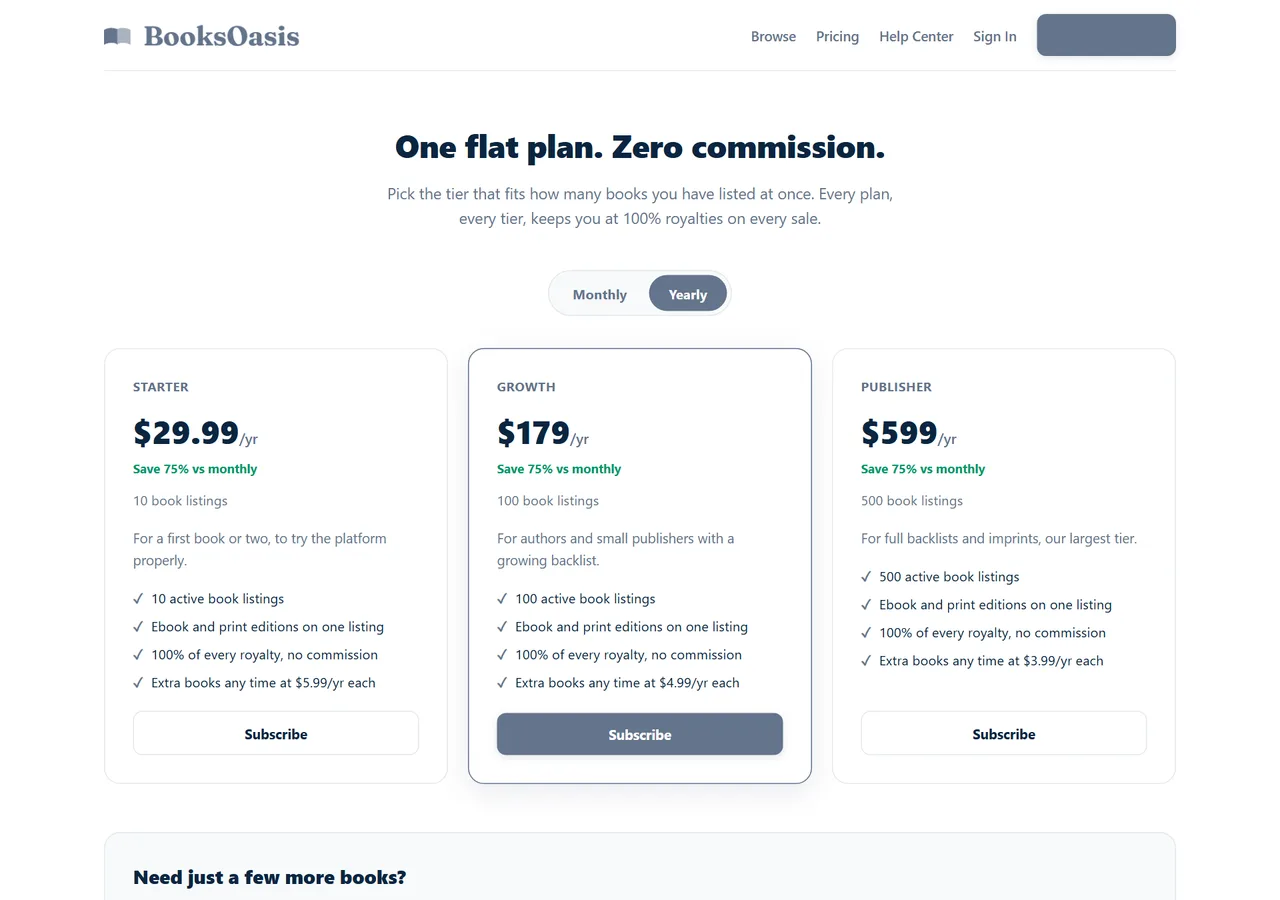
- Flat plans from $29.99 a year for 10 books.
- Open to authors worldwide, with payouts by bank transfer or PayPal.
Payments and tax details
Like every major store, Google asks for tax and payment information before it pays you. Complete these in Partner Center before your first sale, so earnings aren't held while paperwork catches up. Payment methods, schedules and any minimums depend on your country, so check the payment settings in your own account rather than relying on another author's experience. Keep a record of each payment alongside your other stores' payouts.
Three authors, three setups
An author in a country not yet supported for Google Play seller sign-ups reaches Google Play through an aggregator and lists every book directly on BooksOasis.
A thriller author with many Android readers went direct to Google Play to keep the full split, and runs promotions there without worrying about price bands.
A cosy mystery author for whom Google was a small share keeps it inside an aggregator, and puts promotional effort into the stores that sell most.
Keeping track across stores
Every store you add is another report to read, another tax form to keep current and another payment to reconcile at the end of the month. Keep one spreadsheet with each store's monthly earnings, check it every few months, and let the numbers decide where to go direct and where an aggregator is enough. See bookkeeping for authors and international author payouts if you're outside the US.
Where BooksOasis fits
- A store you list on directly, alongside Google Play.
- 100% of the ebook price, with print on demand.
- Oasis Reader runs in any modern browser, including on Android.
What it doesn't do: BooksOasis doesn't distribute to Google Play or other stores, and it isn't indexed in Google Books previews.
See plans and pricingSources
Checked October 2026: Google Play Books revenue split; Partner Center overview; Partner Center: create an account; KDP ebook royalty options.
In short
Google Play Books Partner Center pays 70% on list price in most supported countries, with no price bands. Go direct if you can sign up and Google matters to your readers; otherwise reach it through an aggregator. Then add the stores that reach everyone else, including one where you keep 100% of the ebook price and readers can read on any device.
Questions
What does Google Play Books pay authors?
Google says partners who accepted its 2019 terms get a 70% revenue split on ebook sales in most supported countries. Some countries, and partners who haven't accepted the updated terms, get a different split, which Google gives as 52%.
Is the Google Play split on list price or sale price?
Google says it pays the revenue split on the list price.
Do I need to price within a band for 70% on Google Play?
No. Google says you no longer need to list within certain price bands to get the 70% split, where it applies.
Which countries get the 70% split?
Google lists more than 60 countries, including the US, UK, Canada, Australia and most of Europe. Sales in Hong Kong, India, Indonesia, Japan, Malaysia, the Philippines, Singapore, South Korea, Taiwan, Thailand and Vietnam keep your current split.
Can anyone sign up for Google Play Books Partner Center?
You need to be in a country supported for seller sign-ups. Google suggests checking back later if yours isn't supported yet.
What if my country isn't supported for seller sign-ups?
Use an aggregator that distributes to Google Play, such as Draft2Digital or PublishDrive, and sell direct elsewhere.
Is it worth going direct to Google Play?
If Google is a meaningful share of your sales or your readers use Android, yes, since you keep the full split. If not, an aggregator is simpler.
What are the alternatives to Google Play Partner Center?
Reaching Google Play through an aggregator, publishing direct to other stores such as Apple Books and Kobo Writing Life, and adding BooksOasis, where you keep 100% of the ebook price.
Can Android readers read BooksOasis ebooks?
Yes. Oasis Reader runs in any modern browser, including on Android phones and tablets, with nothing to install.
Can I sell on Google Play and BooksOasis at the same time?
Yes. Neither requires exclusivity.
Add a store where you keep 100%
List directly on BooksOasis alongside Google Play. Plans from $29.99 a year.