New releases get the attention, but for many authors the backlist is where the steady money is. Every older book is a way for a new reader to discover you, and a reader who enjoys one book often goes looking for the rest. Yet backlists are easy to neglect: covers age, descriptions go stale, links break. This guide covers how to audit your backlist, what to refresh first, how to reissue books whose rights have come back to you, and how to keep older books selling.
Why the backlist matters
A launch is a spike; a backlist is a baseline. Ten older books each selling a handful of copies a month can out-earn a new release over a year, and they keep going without a launch budget. They also multiply the value of every new reader: someone who discovers your latest book and loves it can go on to buy several more from your catalogue. The bigger and better-maintained your backlist, the more each new reader is worth.
Step 1: audit what you have
Start with a list of every book, with a row for each format. Record what you need to make decisions:
| Column | Why |
|---|---|
| Title, series and number | See gaps and connections |
| Formats and stores | Find missing formats and stores |
| Sales over the last 12 months | Spot winners and sleepers |
| Cover age and quality | Candidates for a refresh |
| Description quality | Quick wins |
| Back matter links | Books that don't point onward |
| Rights status | Books you control vs licensed to a publisher |
Which books to work on first
With a large backlist, you can't refresh everything at once, so prioritise. The best candidates are usually first books in a series, because every improvement there flows through to the later books; books in genres that are selling well right now; and books that once sold strongly and then faded, which often means the story still works but the packaging has aged.
At the other end, a book that has never sold well despite a decent cover and description may simply not have found its audience, and it may be better to spend your time elsewhere. Sort your audit by potential, not by age, and work down the list. Two or three well-chosen refreshes often do more than a dozen small tweaks spread across the whole catalogue.
Keep a note of what you changed and when, so you can compare sales before and after. A backlist refresh is easier to justify, and easier to repeat, when you can see which changes paid off.
Step 2: refresh covers and descriptions
Covers date faster than stories. A cover that looked right ten years ago can signal "old" or even the wrong genre today. If a book's cover no longer matches what readers in its genre expect, a new one is often the single most effective change you can make. For a series, refresh the whole set so the books look like they belong together.
Descriptions are cheaper to fix and just as important. Many older descriptions ramble, bury the hook or describe the plot instead of selling the experience. Rewrite them with a strong opening line, clear stakes or promise, and a closing line that tells readers who'll love the book. See writing a book description.
Step 3: connect every book
- Link books into series on every store, with the right numbers and reading order.
- Update back matter so each book points to the next one, and standalones point to a book readers will enjoy next.
- Refresh links to stores and your newsletter; old links break.
- Keep your author page complete, so a reader who finds one book sees all of them.
See turning readers into series readers for how much these links can add.
Step 4: fix the text only where it matters
Resist the urge to rewrite everything. Readers who enjoyed the book as it was will keep enjoying it. A light pass for typos, formatting problems and badly dated references, such as obsolete technology in a book meant to feel current, is usually enough. Save full rewrites for books that no longer represent your work, and treat them as new projects with their own budget.
Step 5: add formats and stores
Many older books exist in only one format or on only one store. Adding an ebook to a print-only book, a paperback to an ebook-only book, or a hardcover for readers who want a keepsake, widens the audience at little cost. Adding stores reaches readers who don't shop where you've been selling. Every new format and store is another door into your catalogue.
Reissuing books whose rights reverted
Traditionally published authors often have books that went out of print and whose rights have reverted to them. These can be a valuable source of backlist income, but check a few things first. This is general information, not legal advice.
| Check | Why |
|---|---|
| Written reversion of rights | You need confirmation that the rights are yours again |
| Which rights reverted | Some contracts revert print but not ebook, or vice versa |
| Cover and interior | The publisher usually owns the cover art and typesetting |
| ISBN | The old ISBN belongs to the publisher's edition; a new publisher normally needs a new one |
| Title and text | Use your own final manuscript, not the publisher's edited files, unless your contract allows it |
With the rights confirmed, a reissue is a chance to give the book a cover that suits today's market and to link it with your newer work. See ISBNs for self-publishers.
Pricing older books
An older book doesn't have to be cheap, but its price should make sense next to your newer work. Readers compare. If book one of an old series costs more than your latest release, it can put new readers off at the door. Many authors keep series starters at an easy entry price and later books at their normal price, and review backlist prices once a year so the catalogue feels consistent. See series pricing strategy for more.
Promotions for backlist books
You don't need a new release to promote. Backlist promotions that work well include a discount on the first book of a series, a themed sale of several books with a seasonal hook, and a newsletter feature on an older book your newer readers may not know. Time promotions around your new releases too: a sale on an earlier book the week a new one launches brings readers into your catalogue at the start. See ebook promotions.
Using your newsletter for the backlist
New subscribers often joined after reading your latest book and have no idea what else you've written. An automated welcome sequence that introduces your backlist, one book or series per email, can sell older books for years without further effort. Regular newsletters can feature a "from the backlist" book each time, with a sentence on why readers of your recent work will enjoy it.
Pen names and imprints
Authors with long careers often have books under several names, or books that sit better under a separate imprint. Keep each name's books grouped so readers of one pen name find its full catalogue, and decide deliberately whether to connect pen names publicly. See publishing under a pen name.
Listing a big backlist on BooksOasis
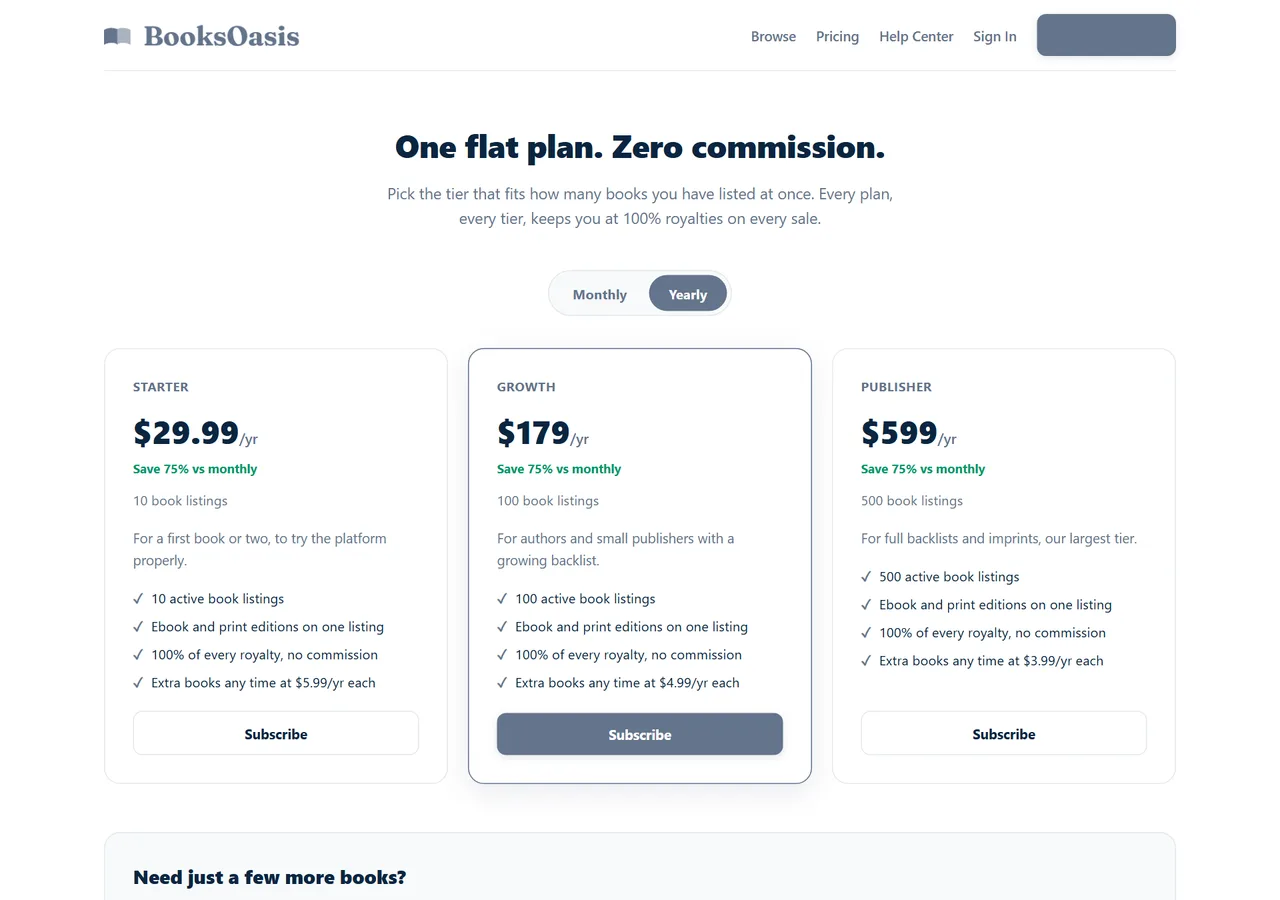
| Plan | Books | Price |
|---|---|---|
| Starter | 10 | $29.99 a year |
| Growth | 100 | $179 a year |
| Publisher | 500 | $599 a year |
- No commission on ebooks. Every ebook sale pays you its full price, whether the book is new or twenty years old.
- Ebook, paperback and hardcover on one listing, each priced separately. Print pays the price minus printing and a handling fee of 30% of that printing cost.
- ISBNs optional, so you can list reissues without buying new ISBNs if you don't need them.
- Unlimited pen names and imprints on one account, each with its own page.
- Series pages with reading order, and promotional prices with start and end dates.
A backlist refresh plan
- Month 1: audit the catalogue; fix broken links and back matter everywhere.
- Month 2: rewrite the weakest descriptions; add missing formats.
- Month 3: commission new covers for the books or series with the most potential.
- Month 4: add new stores; list the whole backlist in one place readers can browse.
- Ongoing: a backlist promotion every few months, and a backlist feature in each newsletter.
Where BooksOasis fits
- Flat plans by number of books, up to 500 for $599 a year.
- 100% of every ebook sale, with ebook, paperback and hardcover on one listing.
- Optional ISBNs, unlimited pen names and imprints, and series pages.
What it doesn't do: BooksOasis doesn't design covers, rewrite descriptions or check your publishing contracts, and it doesn't distribute to other stores.
See plans and pricingThree backlists, three second lives
A thriller author with twelve older books refreshed the covers of one series and rewrote its descriptions, and the series began selling steadily again.
A former traditionally published author got the rights back to three out-of-print novels, reissued them with new covers, and linked them to their newer self-published work.
A non-fiction author added paperback editions to ebook-only guides and a welcome email series introducing each one to new subscribers.
In short
Audit every book, refresh what looks dated, connect each book to the next, add formats and stores, and promote the backlist as deliberately as new releases. Older books are a quiet engine for your career, and with a little care they keep bringing new readers to everything you write.
Questions
What is a backlist?
All of an author's or publisher's books that are no longer new releases. For many authors, the backlist earns more over time than any single launch.
How do I make old books sell again?
Audit them, refresh covers and descriptions that look dated, link books into series, update back matter, add formats and stores, and run occasional promotions.
Can I republish a book whose rights reverted from a publisher?
If the rights have genuinely reverted to you in writing, generally yes. You usually can't reuse the publisher's cover, interior design or ISBN; check your contract and reversion letter, and take legal advice if unsure.
Do I need a new ISBN to reissue a book?
If you're publishing it as a new publisher, a new ISBN is normally needed, since the old one identifies the original publisher's edition. On BooksOasis, an ISBN is optional.
Should I rewrite old books?
Only if they genuinely need it. A light edit for errors and dated references is often enough; a full rewrite is a new project.
Is a new cover worth it for an old book?
Often, yes. Covers date faster than stories. A cover that matches current genre expectations can transform sales of an older book.
How do I promote a backlist without new releases?
Promotions on series starters, themed sales, newsletter features of older books, and linking every book to the next one in back matter.
What does it cost to list a big backlist on BooksOasis?
Plans are $29.99 a year for 10 books, $179 for 100 and $599 for 500, with no commission on ebook sales. Each book can have ebook, paperback and hardcover formats.
Can I list books under different pen names?
Yes. BooksOasis supports unlimited pen names (author profiles) and imprints (publisher profiles) on one account.
Should I take old books off sale?
Rarely. A book that sells a few copies a year still earns, and every book is a way for a reader to find you. Improve it rather than removing it, unless it truly doesn't represent your work any more.
List your whole backlist
Plans from $29.99 a year for 10 books, $179 for 100 and $599 for 500. Keep 100% of every ebook sale.