Series are the backbone of many indie authors' incomes. A standalone sells once per reader. A series can sell five, ten or twenty times to the same reader, if they keep going. That "if" is where read-through comes in. This guide explains how to measure it, where readers usually drop off, and what you can do at each step to keep them reading.
Why read-through drives series income
Here's a simple illustration. Imagine a five-book series where each book costs $4.99 and read-through is 60% from book one to two, then 80% for each later step. For every 100 readers of book one, the series sells:
| Book | Readers | Sales at $4.99 |
|---|---|---|
| Book 1 | 100 | $499 |
| Book 2 | 60 | $299 |
| Book 3 | 48 | $240 |
| Book 4 | 38 | $190 |
| Book 5 | 31 | $155 |
| Total | 277 books | $1,383 |
Illustration only; rounded. Your rates and prices will differ.
Each reader of book one is worth about $13.83 across the series, nearly three times the price of the first book. Now imagine lifting the first step from 60% to 70%. Every later book gains readers too, and the whole series earns more without a single extra reader at the top. That's why improving read-through is often worth more than finding new readers.
How to measure it
- Choose a period of a few months, ideally without a promotion on just one book.
- Count sales of each book in the series over that period.
- Divide each book by the one before: book two by book one, three by two, and so on.
- Look for the weakest step. That's where to focus.
Read-through is never exact. Some readers buy several books at once, some pause for months, and promotions distort single books. Treat the figures as a guide and watch the trend rather than any single month.
Where readers drop off, and why
| Drop-off | Likely cause | Fix |
|---|---|---|
| Between books one and two | Weak ending hook; no link to book two | A stronger final chapter; the next-book link first in back matter |
| At one particular book | That book changes tone, lead character or pace | Clearer description of what the book is; revise if needed |
| Across the whole series | First book attracts the wrong readers | Revisit the cover, description and genres of book one |
| At the latest book | Readers don't know it's out | Newsletter announcement; update earlier back matter |
The ending that sells the next book
The most powerful sales tool for book two is the last chapter of book one. Readers who close a book satisfied but curious buy the next one. That doesn't mean a cliffhanger every time; many readers dislike them. It means resolving the main story of this book while leaving a question about the characters, the world or what comes next that the reader wants answered.
Back matter: the page after "The End"
The moment a reader finishes your book is the moment they're most likely to buy the next one. Make it easy:
- Put the next-book link first. Before acknowledgements, before the author bio.
- Add one or two lines on what happens next, or the first line of the next book.
- Invite them to your newsletter so they hear when the next book is out.
- Keep it short. Readers skim back matter; the link has to jump out.
- Update it whenever a new book comes out, so earlier books point to it.
Make the series obvious
Readers can't continue a series they don't know exists. Put the series name and number on the cover and in the subtitle, such as "A Seaside Bakery Mystery, Book 1". Use consistent cover design so the books look like a set. Make sure every book is linked to the series on every store, so readers can see the reading order at a glance.
Pricing the entry point
Book one is the door into the series. Many authors price it lower than later books, or run it on promotion now and then, so that trying it feels low-risk. The later books then sell at full price to readers who are already invested. See series pricing strategy and ebook promotions.
Keep readers between books
When the next book isn't written yet, readers can drift away. A newsletter keeps them close: tell them how the next book is going, share a cover reveal, and open a pre-order as soon as you have a date. A pre-order lets readers finishing the current book commit to the next straight away. See pre-orders for indie authors.
Box sets and omnibus editions
Once a series has three or more books, some authors publish a box set: several books in one ebook, often at a lower price than buying each separately. A box set appeals to readers who like to binge, and it can reach readers who never saw the individual books. It also changes the read-through picture, because a box-set reader has already committed to several books at once. The next step to measure is from the box set to the book that follows it.
A box set works best alongside the individual books rather than instead of them. Some readers want to try one book first; others want the whole set. Offering both lets each reader choose, and a box set's back matter should point to the next book just as clearly as any single book does.
Connected standalones
Not every series has to be one continuing story. Many authors write connected standalones: books set in the same town, world or family, each with its own complete story and a different lead character. Read-through works a little differently here, because readers can start anywhere. The job of the back matter is the same, though: tell the reader which book to read next and why they'll enjoy it. On BooksOasis, an unordered series suits this kind of collection, since readers aren't told there's a fixed order.
How series work on BooksOasis
- Create a series and choose ordered, for a set reading sequence, or unordered, for books that share a setting or theme.
- Choose the label readers see: Book, Volume or Part.
- Add each book to the series from its own listing, when you create it or later.
Readers then see the series in several places:
- On each book page, a line such as "Book 2 of 5" links to the series, and an Also in this series shelf shows the other books.
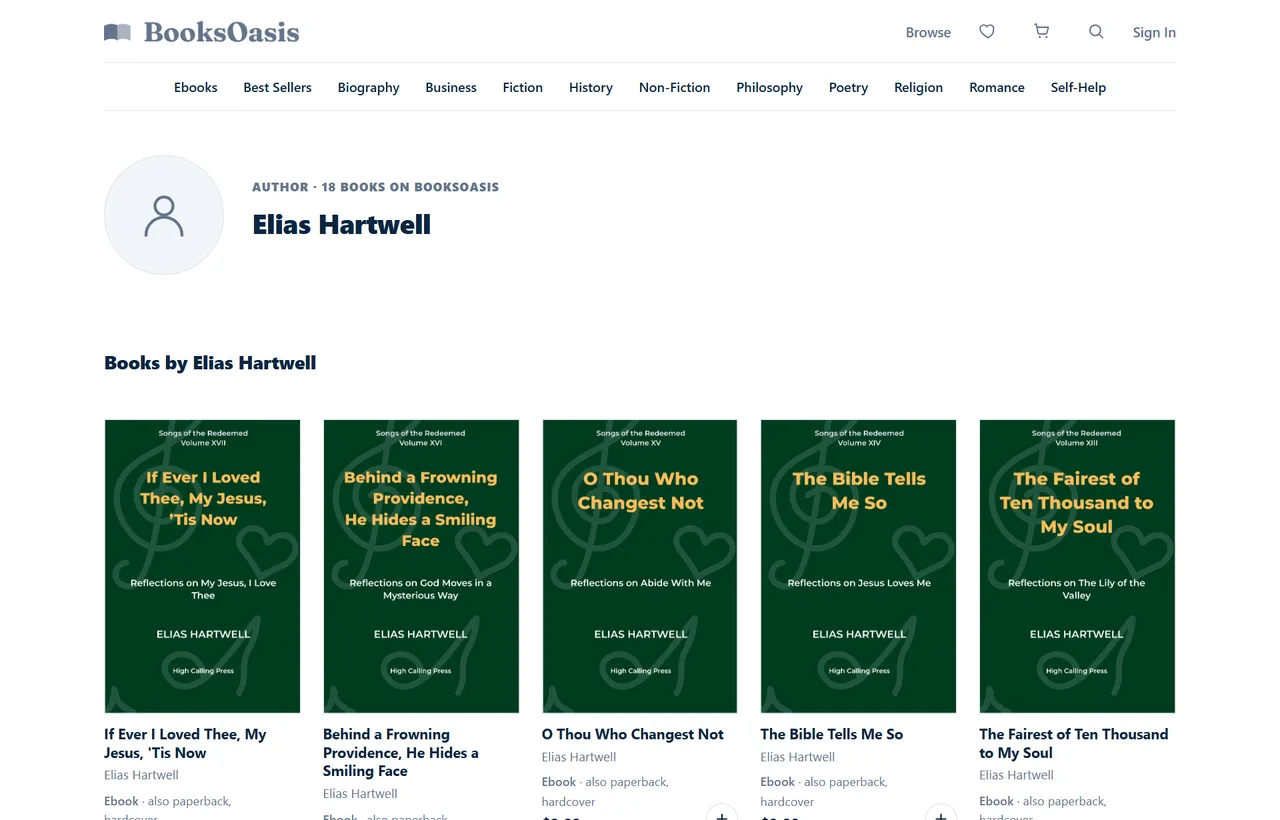
- On the series page, every book is listed in reading order with its number and a short description, and readers who own some books can hide them to see what they still need.
- A box to buy several ebooks at once: first 3, first 5, first 10 or all, priced at the total of the individual ebook prices, with books the reader already owns left out.
- On the homepage, a Best Series shelf, and search matches series names.
- Upcoming books show a Pre-order ebook button with the release date.
Every ebook in the series pays you its full price, so strong read-through adds up directly.
Listen to what readers tell you
Reviews and reader emails are a free window into read-through. When readers say they couldn't put a book down and went straight to the next, you know the ending works. When several mention that a middle book felt slow, or that they missed a favourite character, you know where readers are drifting. Keep a simple note of recurring comments per book. Over a series, the patterns are often clearer than any sales figure, and they tell you not just where readers stop but why.
Common read-through mistakes
- No link to the next book in back matter, or a link buried after pages of acknowledgements.
- Forgetting to update old books when a new one is released.
- Inconsistent covers that don't look like a series.
- Books not linked to the series on every store.
- A long silence between books with no newsletter to keep readers engaged.
Where BooksOasis fits
- Ordered or unordered series, with a reading order and Book, Volume or Part numbering.
- Series pages, an Also in this series shelf, and a box to buy several ebooks at once.
- Series pre-orders, so readers can commit to the next book early.
What it doesn't do: BooksOasis doesn't write your back matter or discount a series automatically; buying several books together costs the total of their prices, and you choose any promotional prices.
See plans and pricingThree series, three fixes
A fantasy author found read-through from book one to two was far below later steps, moved the next-book link to the first page of back matter, and saw book two sales rise.
A mystery author noticed readers stopped at book four, the only one with a different narrator, and rewrote its description to set expectations.
A romance author put each next book on pre-order before the current one launched, so every new reader had somewhere to go.
In short
Measure read-through step by step, find where readers stop, and fix that step: a stronger ending, a next-book link first in the back matter, consistent series branding, an easy-to-try first book and a newsletter between releases. Every point you add at the first step carries through the whole series.
Questions
What is read-through?
The share of readers of one book in a series who go on to buy the next. If 100 people buy book one and 60 buy book two, read-through from book one to two is 60%.
How do I calculate read-through?
Divide sales of the next book by sales of the previous one over the same period, ideally a period without promotions that distort one book. Track each step: book one to two, two to three, and so on.
What's a good read-through rate?
It varies by genre and series. What matters most is spotting where readers drop off in your own series and improving that step.
Why does read-through matter so much?
Because each reader of book one can be worth several sales. Strong read-through means a sale on book one earns far more than its price over time.
Where do readers usually drop off?
Most often between book one and book two. Reasons include a weak ending hook, no link to the next book, or a book that doesn't match the promise of the first.
What should go in back matter?
A short thank-you, a direct link to the next book, a sentence on what happens next, and a newsletter invitation. Keep it short, and put the next-book link first.
Should the first book be cheaper?
Many series authors price book one lower, or put it on promotion, because it's the entry point. The later books then sell at full price to readers who are hooked.
How do series work on BooksOasis?
You create a series, choose ordered or unordered and a label (Book, Volume or Part), and add each book to it. Readers see a series page in reading order, a 'Book 2 of 5' link on each book page, an Also in this series shelf, and a box to buy several ebooks at once.
Does buying a whole series on BooksOasis cost less?
The series box price is the total of the individual ebook prices, with books the reader already owns left out. Authors can set promotional prices on individual books.
Does a series need to be finished before I publish?
No, but readers value knowing what's coming. Put the next book on pre-order, or tell readers when to expect it.
Give your series a proper home
Ordered series pages, reading order, and a box to buy several books at once.