Selling direct means readers buy from a store you control, you keep more of each sale and you see who your buyers are. Books.by and Payhip are two of the most common choices for authors, but they're built for different things. This guide compares them on fees, formats, what you keep per sale, payouts, customer data and tax, with figures checked at each platform's own pricing page.
At a glance
| Books.by | Payhip | |
|---|---|---|
| What it is | A bookstore for authors | A store for any digital product |
| Pricing | Core $99/yr; Pro $299/yr | Free (5%); Plus $29/mo (2%); Pro $99/mo (0%) |
| Processing | 2.9% + $0.30 per transaction | PayPal or Stripe standard rates |
| Ebooks | Pro plan only | All plans |
| Print on demand | Yes, paperbacks | No; physical products you ship yourself |
| Customer data | Yes | Yes |
| Payouts | Daily, via Stripe | Through your own PayPal or Stripe account |
| Tax | Check current terms | Collects and remits EU and UK VAT |
Checked October 2026 at each platform's pricing page.
What you keep on a $4.99 ebook
| Store | Deductions | You keep (approx.) |
|---|---|---|
| Books.by Pro | 2.9% + $0.30 processing | $4.55 |
| Payhip Free | 5% + Stripe processing (2.9% + $0.30 assumed) | $4.30 |
| Payhip Plus | 2% + processing | $4.45 |
| Payhip Pro | Processing only | $4.55 |
| BooksOasis | None | $4.99 |
Per-sale figures only, before each plan's yearly or monthly fee. Processing rates vary by country and method.
What you keep on a $19.99 paperback
Books.by's own worked example for a $19.99 paperback shows a printing cost of $4.46 passed through at cost, card processing of $0.88, and $14.65 to the author, with shipping paid by the customer. Printing costs depend on the book's size and page count, so your figure will differ.
Payhip doesn't print books. To sell paperbacks there, you'd buy stock, store it and post each order yourself, or connect a separate print service. For many authors, that's the deciding factor: if print matters, Books.by or a bookstore that prints on demand is simpler.
Yearly fee vs per-sale cut: the break-even
Books.by charges a fixed yearly fee; Payhip Free charges a percentage. Which costs less depends on how much you sell. For ebooks, Books.by Pro's $299 a year equals Payhip Free's 5% cut at about $5,980 of yearly sales. Below that, Payhip Free costs less in fees; above it, Books.by Pro does. Payhip Plus, at $348 a year plus 2%, sits between them.
| Yearly ebook sales | Payhip Free fee (5%) | Books.by Pro fee |
|---|---|---|
| $1,000 | $50 | $299 |
| $5,000 | $250 | $299 |
| $10,000 | $500 | $299 |
Platform fees only; card processing applies to both.
Features beyond the fees
Books.by is built around books. Its pricing page lists free ISBNs, a cover builder, daily payouts to your bank via Stripe, and on Pro, pre-order campaigns, discount codes, sales analytics, multi-currency selling and a Facebook Pixel. It also advertises a 100-day money-back guarantee on both plans.
Payhip is built for any digital creator. Every plan includes the same features, including courses, memberships and coupons, so authors who also sell workbooks, courses or bonus content can run everything from one store. Its EU and UK VAT handling is a real convenience for authors with European buyers.
Payouts and cash flow
How quickly money reaches you matters, especially around a launch. Books.by lists daily payouts to your bank account through Stripe. Payhip connects to your own PayPal or Stripe account, so money from each sale lands there and follows PayPal's or Stripe's own payout timing. Either way, direct stores usually pay much faster than large retailers, which often pay one to two months after the month of sale. See how author payouts work for a comparison across platforms.
One practical difference: with Payhip, you manage your PayPal or Stripe account yourself, including any disputes or chargebacks raised through them. Books.by also runs payments through Stripe. In both cases, it's worth reading the payment provider's terms so a refund request or card dispute doesn't catch you by surprise.
Delivering ebooks to readers
With both stores, a reader who buys an ebook receives a file to download, usually an EPUB or PDF. That's convenient for readers who want to load the book onto their own device or app, but it also means some readers will need help getting the file onto an e-reader. Many authors add a short "how to read your ebook" note to their store or confirmation email. It saves support emails and makes the direct-purchase experience feel as smooth as buying from a big store.
A note on ISBNs
Books.by lists free ISBNs among its features, which can save money if you need one for a paperback. Payhip doesn't need ISBNs for digital products at all. If you plan to sell the same edition in several places, owning your own ISBN lets you keep it consistent everywhere, and a free ISBN from a platform may list that platform as the publisher. See ISBNs for self-publishers for the trade-offs.
Which to choose
| If you... | Consider |
|---|---|
| Want to sell paperbacks direct without handling stock | Books.by |
| Sell only ebooks and are just starting | Payhip Free |
| Sell ebooks plus courses or memberships | Payhip |
| Sell a lot of ebooks and paperbacks direct | Books.by Pro |
| Want readers who browse, plus ebooks and print | A bookstore such as BooksOasis, alongside your own store |
Look, branding and the buying experience
A direct store is a shop window for your author brand, so how it looks matters. Books.by gives each author a bookstore page at books.by/your-name, designed around books: covers, formats and prices presented the way readers expect from a bookshop. Payhip gives you a storefront and product pages you can customise, which suits authors who sell a mix of books and other products and want the store to feel like part of their own brand.
Whichever you choose, the basics decide whether a visitor buys: a clear cover image, a strong description, a visible price, and a simple checkout. Test the whole journey yourself on a phone before you send readers there, since that's where many of them will arrive from a newsletter or social post. If the checkout asks for more than readers expect, or the page loads slowly on mobile, you'll lose sales no matter how low the fees are.
The traffic question
Both Books.by and Payhip are your own storefront. That's their strength: you control the page and own the customer list. It's also their limitation: readers mostly arrive because you sent them, through your newsletter, website, social media or ads. Neither is a place where large numbers of readers browse for their next book. Many authors therefore combine a direct store for their own audience with a bookstore where new readers can discover them.
Where BooksOasis fits
BooksOasis is a shared bookstore: readers browse genres, series, new releases and books on sale from many independent authors. For authors:
- 100% of the ebook price, with no per-sale cut and no processing deducted from you.
- Print on demand for paperbacks and hardcovers; print pays the price minus printing and a handling fee of 30% of that printing cost, and readers pay shipping.
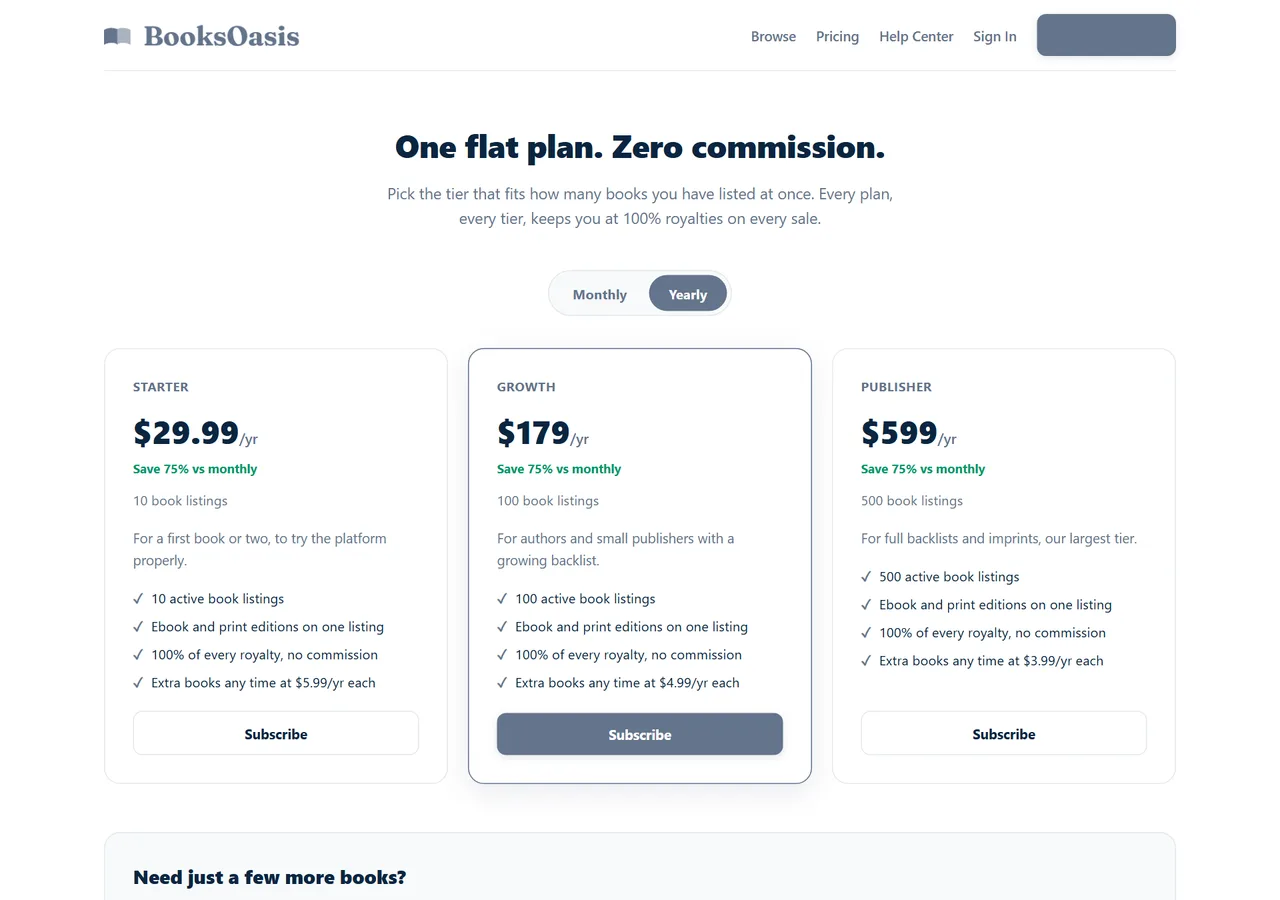
- Flat plans: $29.99 a year for 10 books, $179 for 100 and $599 for 500.
- Series pages, pre-orders and promotional prices built in.
Using them together
These stores aren't mutually exclusive. A common setup is to point newsletter readers to a direct store where you capture emails and offer bundles or signed copies, while listing every book on a bookstore where browsing readers find you. Keep prices consistent across stores so no reader feels they paid more than necessary, and link each store from your website so readers can choose.
Switching later
Because both are your own storefront, moving between them is mostly a matter of re-uploading files and updating links. The harder part is your links: every newsletter, back-matter page and social profile that points to the old store needs updating. If you think you might switch, send readers to a page on your own website that links to your store, so you only ever change one link.
Three authors, three choices
A debut novelist with a small newsletter and ebooks only started on Payhip Free, paying nothing until sales came in, and planned to review the choice once yearly sales passed a few thousand dollars.
A memoir author whose readers mostly want paperbacks chose Books.by Core, so each copy prints on demand without boxes of stock in the spare room.
A non-fiction author selling an ebook, a workbook and a short course used Payhip for everything digital, and listed the book in a bookstore where browsing readers could find it in print and as an ebook.
Where BooksOasis fits
- A bookstore readers browse, with ebooks, paperbacks and hardcovers on one listing.
- 100% of the ebook price and flat plans from $29.99 a year.
- No exclusivity, so it works alongside Books.by or Payhip.
What it doesn't do: BooksOasis doesn't give you buyers' email addresses or a store on your own domain; readers buy from BooksOasis.
See plans and pricingSources
Checked October 2026: Books.by pricing; Payhip pricing.
In short
Choose Books.by if you want print-on-demand paperbacks in your own store for a yearly fee, and Payhip if you mainly sell ebooks and digital products and want to start with no upfront cost. Either way, your own store serves the readers you bring. Add a bookstore where readers browse, and you give new readers a way to find you too.
Questions
What's the main difference between Books.by and Payhip?
Books.by is a bookstore for authors with print on demand, charged by a yearly plan. Payhip is a general digital-products store charged by a per-sale cut or a monthly plan, with no print on demand.
How much does Books.by cost?
Books.by lists Core at $99 a year (paperbacks only) and Pro at $299 a year (ebooks and paperbacks). Card processing of 2.9% + $0.30 per transaction comes out of each sale.
How much does Payhip cost?
Free: no monthly fee and 5% per sale. Plus: $29 a month and 2%. Pro: $99 a month and no transaction fee. PayPal or Stripe processing applies on every plan.
Can I sell paperbacks on Payhip?
Payhip supports physical products, but it doesn't print books. You'd need to hold stock and ship orders yourself. Books.by prints each paperback on demand.
Can I sell ebooks on Books.by Core?
No. Books.by lists Core as paperback-only; ebooks need the Pro plan.
What do I keep on a $4.99 ebook?
Roughly $4.55 on Books.by Pro after card processing, and roughly $4.30 on Payhip Free after its 5% and Stripe processing. On BooksOasis, the author receives the full $4.99.
Which is cheaper for a new author?
For ebooks only, Payhip Free has no upfront cost. Books.by Pro's $299 a year only beats Payhip Free's 5% once yearly sales pass about $5,980, before processing.
Do both give me customer emails?
Yes. Both are your own storefront, and you keep buyers' details, which helps build a mailing list.
Which handles sales tax?
Payhip says it collects and remits EU and UK VAT on digital sales automatically. Check Books.by's current terms for how it handles tax where you sell.
Where does BooksOasis fit?
BooksOasis is a shared bookstore where readers browse books from many authors. You keep 100% of the ebook price and it prints paperbacks and hardcovers on demand, from $29.99 a year for 10 books. It doesn't give you buyers' email addresses, so many authors use it alongside their own store.
Ebooks and print, 100% of the ebook price
A bookstore readers browse, from $29.99 a year for 10 books.